

Table of Contents
- Why Barbers Are Moving Beyond Aerosol Sprays
- Barbicide Alternatives for Barbers: Non-Spray Options
- Clipper Disinfectant Spray Alternatives: Multi-Purpose Solutions
- Disinfecting Barber Shears and Combs Without Spray
- Barber Station Surface Disinfectant Options
- EPA Registration, Contact Time, and Label Directions
- Cost Per Use and Operational Trade-Offs
- Frequently Asked Questions
Last Updated: October 12, 2026
Why Barbers Are Moving Beyond Aerosol Sprays
Aerosol disinfectant sprays have been the default for decades: fast, portable, familiar. But they bring overspray waste, inhalation concerns in enclosed spaces, and single-use can waste.
The shift isn't about abandoning disinfection, it's about doing it smarter. Barbers need tools that kill bacteria, fungi, and viruses reliably, fit the workflow behind the chair, and avoid compliance headaches.
Below are five practical alternatives, from pre-moistened wipes to sonic cleaning, that give you more control, better tool care, and often lower total cost than spray alone.
Barbicide Alternatives for Barbers: Non-Spray Options
Non-spray disinfectant options give you precision aerosols can't match: you control how much product touches each tool, eliminate overspray waste, and can verify you've hit the label's contact time.
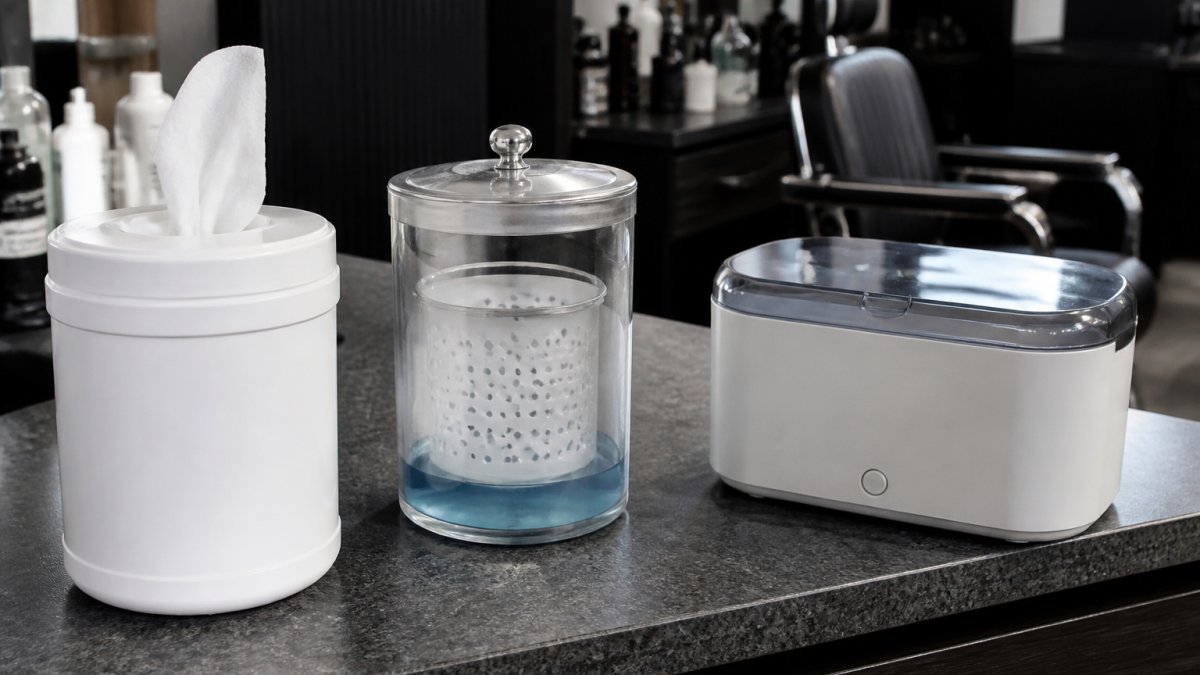
Pre-Moistened Disinfecting Wipes
Pre-moistened wipes are the fastest non-spray option for between-client cleanups. Each wipe is saturated with EPA-registered disinfectant, so there's no mixing or guessing. Wipe the tool, hold for the package contact time, done.
Barbicide Wipes 160ct ($17.99) deliver this speed without compromise. They're EPA-registered, kill bacteria, viruses, and fungi, and work on clipper blades, shears, combs, and station surfaces.
One caveat: keep the lid sealed or wipes dry out. They suit quick between-client surface cleaning, not deep tool soaks.
Immersion Jars for Tool Storage
Immersion jars hold tools in disinfecting solution between uses. Unlike spray, the entire tool surface stays in contact with disinfectant the whole time it sits in the jar.
Both jars work with any EPA-registered disinfecting solution sold separately, the solution does the disinfection, the jar is the container. That gives you full control over contact time. Many barbers keep one jar for active tools and rotate fresh sets in, so every tool is fully disinfected before the next client.
Sonic Cleaning Technology
Sonic vibration releases hair, buildup, and debris from blades and shears. The BaBylissPRO Barber Sonic Disinfectant Box ($99.99) combines sonic action with disinfecting solution to clean tools automatically.
It features dual soaking compartments, a removable tray for eight guards, LED illumination, and an automated cycle that starts when you close the lid.
This is the premium option: higher upfront cost, but it saves time in high-volume shops where tool maintenance is constant. Drop in tools, close the lid, and the box handles the rest.
Clipper Disinfectant Spray Alternatives: Multi-Purpose Solutions
Clipper blades need more than disinfection, they need lubrication, cooling, and rust prevention. Sprays disinfect but don't address the full maintenance picture.
Blade Care Solutions That Clean and Lubricate
Andis Blade Care Dip Jar 16 oz. ($14.99) cleans, lubricates, cools, and prevents rust in one step. Dip clipper blades in and it washes away hair, buildup, and preservatives.

This is complete blade maintenance, not just disinfection. Many barbers use it between clients to refresh blades mid-day; it cools blades heated by friction. Unlike fast-evaporating spray, dip solutions coat the blade thoroughly and stay in place.
For clippers, dip solutions outperform sprays because they address the root causes of blade degradation: heat, friction, and buildup.
Disinfecting Barber Shears and Combs Without Spray
Shears and combs are where spray fails hardest: a comb has dozens of contact points between teeth, and a shear has a pivot assembly, tension screw, and finger rest that mist rarely reaches. Immersion is standard for good reason, but not every tool tolerates the same method.
Match the Method to the Material
| Tool | Preferred Method | Watch Out For |
|---|---|---|
| Stainless steel shears | Full immersion in an EPA-registered disinfectant | Prolonged soaking of some coated or colored finishes can dull the surface; check the label for material compatibility |
| Carbon steel shears | Immersion for the label contact time, then dry immediately | Carbon steel rusts fast, never leave it sitting in solution overnight |
| Plastic combs | Immersion or wipe-down | Some disinfectants can cloud or stress certain plastics; test one comb first |
| Carbon combs | Wipe-down or short immersion | Heat and long soaks can warp them |
| Clipper blades | Dip or immersion, then oil | Disinfectant strips oil, so re-lubricate after every soak |
| Wooden-handled tools | Wipe-down only | Never immerse, wood swells, cracks, and traps moisture |
A common pattern in busy shops: one jar for shears, a separate jar for combs, and a blade dip at the clipper station. Keeping categories apart prevents cross-contamination and stops you leaving a carbon steel shear in solution while you finish a cut.
The Sequence That Actually Works
Disinfection is the third step, not the first. The correct order:
- Clean, remove hair, skin, and product residue with soap or a dedicated cleaner. Organic debris shields pathogens and can inactivate disinfectants.
- Rinse and dry, residual cleaner can neutralize the disinfectant.
- Disinfect, fully submerge or wet the tool for the full label contact time.
- Rinse (if directed) and dry, some products require a potable-water rinse before client contact.
- Lubricate, re-oil clipper blades and shear pivots, since disinfectants strip the protective film.
Skipping step one is the most common failure: a shear dropped into disinfectant with hair packed in the pivot isn't being disinfected, it's being marinated.
Contact Time Is Not Optional
Leave shears and combs submerged for the full contact time on the label, commonly 10 minutes for many EPA-registered products, though some are faster or slower. Set a timer. "A few minutes" is not a contact time, and pulling tools early means you cleaned them, not disinfected them.
Barber Station Surface Disinfectant Options
Station surfaces, chairs, armrests, mirrors, countertops, need regular disinfection. Spray is convenient here, but wipes offer more control and less waste.
Barbicide Wipes 160ct work on all station surfaces. The EPA-registered formula kills viruses, bacteria, and fungi. Wipe the surface, let it sit for the contact time, done. No overspray, no fumes, and you can see exactly where you've cleaned.
For high-traffic areas, wipes are faster and more efficient than spray: grab one, clean, discard. No shaking cans or worrying about spray patterns.
EPA Registration, Contact Time, and Label Directions
"EPA-registered" is on every product page, yet almost no barber knows how to check it. That matters: a cleaner, a sanitizer, and a disinfectant are three different things, and only one carries a public, verifiable pathogen-kill claim.
Cleaner vs. Sanitizer vs. Disinfectant
- Cleaner, removes visible soil. No pathogen-kill claim.
- Sanitizer, reduces bacteria on a surface to a level considered safe by public health standards. Narrower claim than a disinfectant.
- Disinfectant, kills or inactivates specific pathogens listed on the label, when used exactly as directed.
A bottle labeled "cleaner" or "sanitizer" is not a disinfectant substitute, no matter how strong it smells. And a disinfectant only performs as one when you follow the label, dilution, contact time, and surface compatibility included.
How to Verify a Product's Registration
Every EPA-registered disinfectant has an EPA Registration Number on the label, usually two or three hyphenated digit groups (for example, 1234-56) (the EPA). Look it up in the EPA's public registration database to confirm the product, registrant, and approved uses. If a product claims to "kill 99.9% of germs" with no registration number, treat it as marketing, not a verified label statement.
EPA pesticide product registration lookup
Contact Time: The Number That Decides Everything
Contact time (dwell time) is how long the surface must stay visibly wet for the kill claim to hold (the EPA). It varies widely by product and pathogen, some formulas list different times for bacteria, viruses, and fungi. Read the row that applies to what you're killing.
If the surface dries before the contact time is up, you cleaned it, not disinfected it. On a warm day in a busy shop, a thin aerosol mist evaporates in seconds, one quiet reason spray underperforms immersion and wipes.
Dilution and Material Compatibility
Concentrates are cheapest per use and easiest to get wrong. If the label says 1:64, that's not a suggestion, over-diluting weakens the kill claim, under-diluting can damage tools and irritate skin. Measure with a dedicated cup, not by eye.
The label also lists approved surfaces. Some disinfectants are fine on stainless steel and plastic but corrode aluminum or dull blade coatings with repeated exposure. If a tool isn't on the approved list, don't assume it's safe.
Cost Per Use and Operational Trade-Offs
Cost per use is the metric that matters.
Barbicide Wipes 160ct at $17.99 covers roughly 2 weeks for a single-chair shop, scaling to multiple packs for multi-chair locations. Andis Blade Care Dip Jar 16 oz. at $14.99 lasts weeks. Fade Supply disinfecting jars ($37.99-$43.99) are one-time purchases that work with any solution you choose.

The $99.99 sonic cleaner costs more upfront, but for shops running 5+ chairs, time savings and consistency justify it.
Most shops combine methods: wipes for quick station cleanups, immersion jars for tools between clients, and sonic cleaning for deep maintenance when time allows.
| Method | Cost Per Use | Speed | Contact Time Control | Best For |
|---|---|---|---|---|
| Aerosol Spray | $8-12/can | Fastest | Low | Quick surface wipes |
| Pre-moistened Wipes | $0.11/wipe | Fast | High | Station surfaces, between clients |
| Immersion Jar | $0.05-0.10/use | Moderate | Very High | Tool storage, thorough disinfection |
| Sonic Cleaner | $0.50-1.00/cycle | Moderate | Very High | High-volume shops, blade maintenance |
| Blade Care Dip | $0.30-0.50/use | Fast | High | Clipper maintenance, lubrication |
Aerosol spray has dominated barber shops because it's convenient, but convenience isn't effectiveness.
Start with one alternative, wipes for station cleanup or an immersion jar for shears, and see how it fits your workflow. Most barbers find mixing methods beats relying on spray alone. Shop Collection to find the disinfection setup that matches your shop's pace and standards.
Frequently Asked Questions
What are the best alternatives to traditional barber disinfectant sprays?
Pre-moistened disinfecting wipes, immersion jars with EPA-registered solutions, sonic cleaning boxes, and multi-purpose blade care products all offer effective alternatives to aerosol sprays. Wipes provide quick station cleanup; immersion jars work for tools between clients; sonic boxes automate the cleaning process. Each format has different contact times and operational workflows, so your choice depends on your shop's volume and setup. EPA-registered options ensure bactericidal, fungicidal, and virucidal activity.
Are Barbicide alternatives as effective as the original product?
Yes, if they're EPA-registered. EPA registration means the product meets federal standards for disinfection claims. Many alternatives use the same active ingredients or comparable germicides. The key difference is format: sprays, wipes, and immersion solutions all kill bacteria, viruses, and fungi, but they work on different timelines and require different contact times. Check the label for specific claims and follow contact time directions for full efficacy.
What's the difference between disinfecting barber shears with spray versus immersion?
Spray provides quick surface disinfection and is convenient between clients, but may not reach all crevices. Immersion in an EPA-registered solution ensures complete coverage of blades, handles, and joints, and typically requires 10-15 minutes of contact time for full disinfection. Immersion jars also keep tools organized. For high-volume shops, a combination approach, spray for quick wipe-downs and immersion for deeper disinfection, works well.
How do I choose between wipes, jars, and sonic cleaning boxes?
Consider your workflow and shop size. Wipes ($17.99 for 160 count) are best for frequent station cleanups between clients. Immersion jars ($37.99-$43.99) work for overnight tool soaking and are ideal for combs, shears, and guards. Sonic cleaning boxes ($99.99) automate the process with vibration and LED light, saving time in high-volume shops. Calculate cost per use: wipes cost roughly $0.11 per wipe; jars require a disinfecting solution (sold separately); sonic boxes have higher upfront cost but reduce labor time.