

Table of Contents
- Essential Tools for Mobile Barbers: What You Need to Succeed
- Professional Hair Clippers and Cordless Equipment
- Trimmers, Detailers, and Precision Cutting Tools
- Portable Barber Station Setup for Mobile Work
- Sanitation Protocols for Mobile Barbers
- Combs, Brushes, Capes, and Client Comfort Essentials
- How to Price Mobile Barber Services and Manage Profitability
- Battery Management and Power Solutions for On-Site Work
Last Updated: August 13, 2026
Essential Tools for Mobile Barbers: What You Need to Succeed
Running a mobile barbering operation means carrying your entire station in a vehicle. Every tool needs to earn its place, and the difference between a smooth service day and a chaotic one comes down to preparation, organization, and the right equipment.
Mobile barbers face unique constraints that traditional shop-based barbers don't encounter: space limitations, power requirements, sanitation on the road, and maintaining professional-grade results without a dedicated workspace. At Fade Supply Co, we've worked directly with independent and mobile barbers to understand what separates thriving operations from struggling ones.

This guide covers essential tools across eight critical categories: professional-grade clippers, portable station setup, sanitation protocols, and the logistics that keep a mobile business profitable. By the end, you'll have a complete framework for building a mobile barbering setup that delivers consistent results while keeping your vehicle organized and your operation efficient.
Professional Hair Clippers and Cordless Equipment
Cordless clippers form the foundation of any mobile barbering setup. Corded equipment limits movement and requires proximity to power outlets, which isn't practical when working from a vehicle or client's home. Cordless clippers give you freedom to position yourself for precision cuts without cable constraints.
Look for clippers with strong motor performance and consistent blade maintenance requirements. Professional-grade cordless clippers maintain cutting power throughout a full day of fades, detail work, and texture cuts. Battery life directly impacts profitability, if your clippers die mid-service, you're losing income.
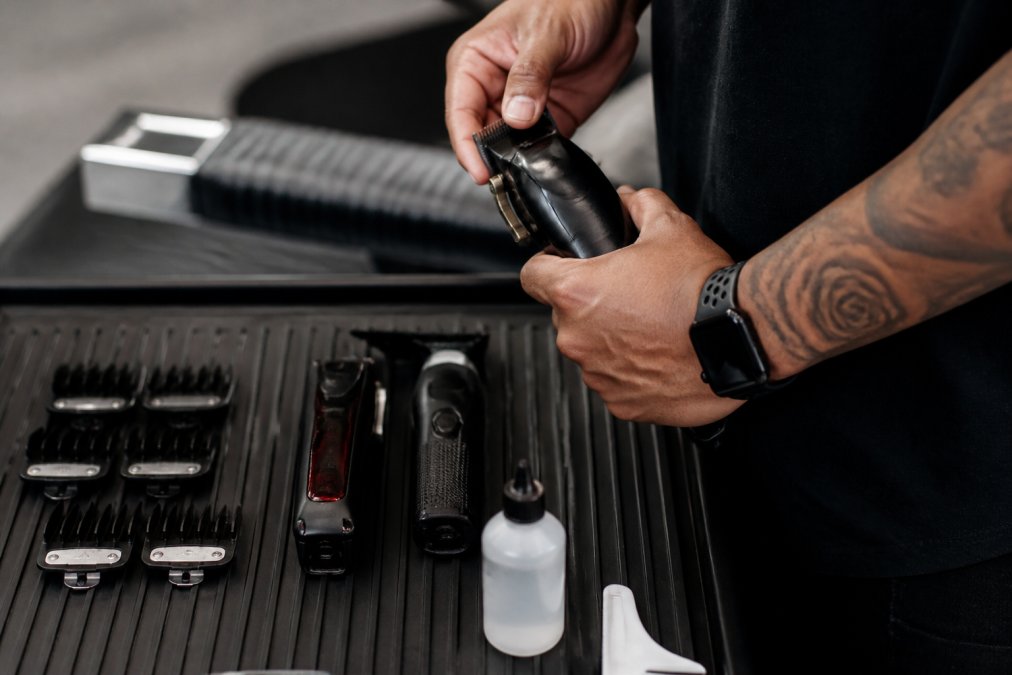
Guard attachments are essential for fade techniques and consistent cutting lengths. You'll want a full range from 0.5mm to 25mm guards depending on your style specialization. Regular blade maintenance, cleaning, oiling, and occasional replacement, extends clipper life significantly. Many mobile barbers keep backup clippers in their vehicle for equipment failures.
Battery management is critical in mobile work. A high-capacity battery delivering 90+ minutes of runtime handles most service days without mid-shift charging. Some cordless clippers support fast-charging, valuable if you have time between clients. Invest in a quality charger that works in your vehicle; a car power inverter paired with a standard wall charger is more reliable than cheap USB solutions.
Trimmers, Detailers, and Precision Cutting Tools
Trimmers handle detail work that clippers can't reach: neck lines, sideburn shaping, and edge definition. A quality cordless trimmer with a precision blade delivers clean lines without vibration that causes inconsistent cuts. For mobile work, carry at least one reliable trimmer; many professionals carry two for backup.
Detailers are specialized trimmers with narrower heads designed for intricate work and sharp line definition. The difference between a good fade and a great one often comes down to detailer precision during final finishing steps.
Straight razors remain essential for clean neck lines and shape-ups. A well-maintained straight razor creates the sharpest possible line work. Store your straight razor safely in a protective case to prevent damage during transport.
Consider carrying both a cordless trimmer and a lightweight corded backup. Cordless is ideal for most work, but a corded trimmer provides unlimited runtime for days when battery backup isn't available. The space tradeoff is minimal, and the reliability benefit is significant.
Portable Barber Station Setup for Mobile Work
Your portable barber station setup determines how efficiently you work and how professional your clients perceive your service. The Fade Supply 3-Layer Mobile Barber Kit ($69.99) provides organized storage with three distinct compartments, keeping clippers, trimmers, capes, and accessories separated and accessible. This structure prevents tools from shifting during vehicle transport and makes setup faster at each appointment.
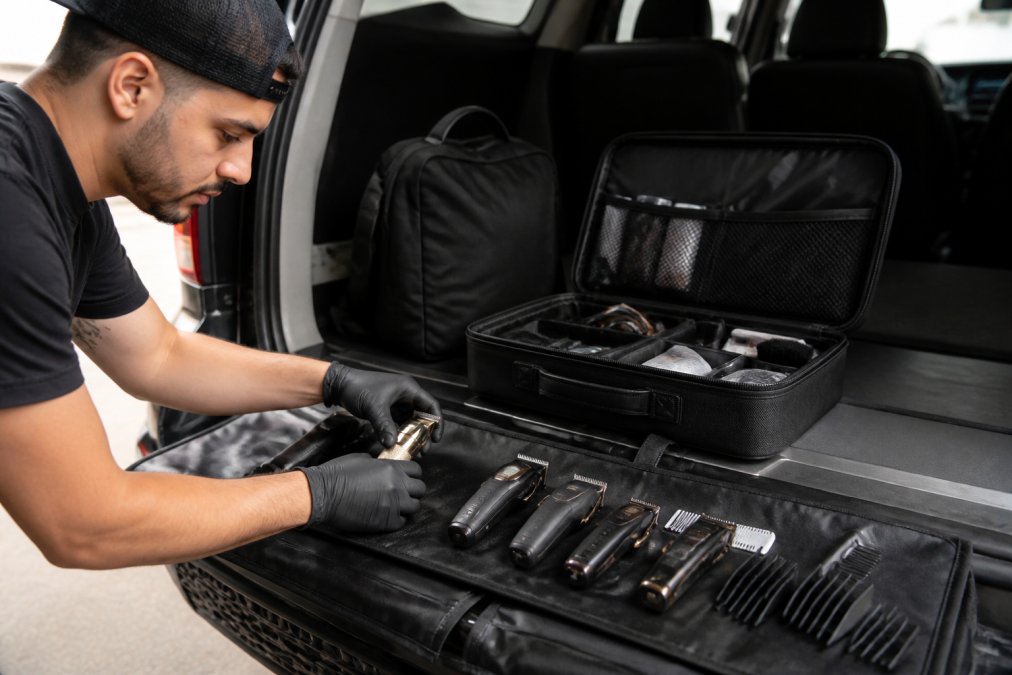
A portable barber station mat creates a defined work surface that protects your tools and organizes them within arm's reach. The Fade Supply Pro Station Mat ($54.99) uses magnetic organization to keep clippers, scissors, and combs in place while you work, eliminating fumbling for tools mid-cut.
Hard-shell cases protect clippers and trimmers from damage during transport. The Fade Supply Hard-Shell Clipper Case ($34.99) and Fade Supply Compact Clipper Case ($39.99) provide protective storage for different equipment configurations. Choose based on your specific tool lineup.
For barbers working multiple appointments daily, the Fade Supply Pro Travel Barber Backpack ($74.99) combines large-capacity storage with water-resistant materials, includes a barber cape and brush, and features USB port access for charging equipment without removing the backpack from your vehicle.
::: Mobile barbers handling 4-8 appointments per day in a vehicle setup who need organized, professional storage that fits in a compact space. :::
The Fade Supply Mobile Barber Backpack ($59.99) offers a lighter-weight alternative with padded storage and a laptop compartment for payment processing equipment.
Sanitation Protocols for Mobile Barbers
Sanitation protocols for mobile barbers are non-negotiable for client health and your professional reputation. You can't use traditional barbershop sterilization equipment in a vehicle, so you need portable solutions that maintain professional standards.
A disinfectant jar with proper solution keeps your combs, guards, and small tools sanitized between clients. The BaBylissPRO Barber Sonic Disinfectant Box ($99.99) uses sonic vibrations to clean tools more effectively than static soaking, with LED illumination and automatic spring lock. This unit operates on batteries or corded power, making it practical for mobile use.
Bring multiple sets of tools so you can rotate them through disinfection while working. If one set goes into disinfectant solution during an appointment, you use a second set for the next client. This rotation system keeps your workflow moving without compromising sanitation.
Neck strips protect clients from loose hair and debris, creating a barrier between the cape and skin. A supply of 100-150 neck strips should last several weeks depending on appointment volume.
Clean your clipper blades between every client with a quick spray of clipper spray followed by light oil application. This 15-second routine prevents blade dulling and maintains cutting performance. For deep cleaning, use a blade brush to remove stubborn debris.
Your cape needs regular washing. The Fade Supply Pro Cape ($24.99) is lightweight and easy to launder, drying quickly for the next day's work. Carry at least two capes so one is always clean while the other is in the wash.

Combs, Brushes, Capes, and Client Comfort Essentials
Client comfort directly impacts your reputation and repeat business. Professional capes protect clothing while projecting quality. The Fade Supply Pro Cape ($24.99) offers clean, lightweight coverage with an adjustable neck closure. Quality material resists staining better than cheaper alternatives.
Combs and brushes serve different purposes. A wide-tooth comb works best for detangling and initial sectioning, while a fine-tooth comb handles precise line work. Barber-specific brushes remove loose hair more effectively than standard combs. Many mobile barbers carry two or three combs for different cut stages.
A duster brush clears loose hair from the client's neck, face, and shoulders before removing the cape. This finishing touch feels professional and prevents post-appointment irritation. A quality duster brush lasts months with proper care.
Neck strips create a barrier between the cape and skin, essential for sanitation and client comfort. These disposable strips prevent cape irritation and reduce laundering frequency. A box of 500 strips costs roughly the same as professional laundering once.
Styling products complete the service. Keep a small selection of pomades, clays, and finishing sprays in your mobile kit, just the 3-4 bestsellers that work with most hair types.
How to Price Mobile Barber Services and Manage Profitability
Pricing mobile barber services requires accounting for factors that fixed-location barbers don't face: travel time, vehicle expenses, and reduced client volume per day. Many mobile barbers underprice their services because they don't calculate true costs.
Start by determining your target hourly rate. If you want to earn $50-75 per hour, factor in travel time between appointments, setup and breakdown time, and the fact that you won't have back-to-back appointments like a shop-based barber. A typical mobile appointment takes 45-60 minutes from arrival to departure, but only 30-40 minutes involves actual cutting.
Calculate your vehicle expenses: fuel, maintenance, insurance, and depreciation. These costs should be factored into your pricing. Many mobile barbers spend $200-400 per month on vehicle-related expenses, which translates to $10-15 per appointment depending on volume.
Mobile barber pricing typically ranges from $40-65 per appointment depending on location, experience level, and service complexity. Beard trims and detail work command higher prices than basic haircuts. Establish clear pricing before confirming appointments.
Consider offering package pricing for regular clients. A monthly subscription for weekly appointments at a slight discount builds recurring revenue and improves scheduling predictability. Track your appointment profitability over time to identify which appointment types and locations are most profitable.
Battery Management and Power Solutions for On-Site Work
Battery management separates reliable mobile operations from frustrating ones. A cordless clipper with a dead battery mid-appointment costs you money and damages your reputation.
Invest in high-capacity batteries for your primary clippers and trimmers. Modern lithium-ion batteries deliver 90-120 minutes of runtime, enough for most service days. Charge fully the night before work and carry a portable charger in your vehicle for emergency top-ups between appointments.
A car power inverter converts your vehicle's 12V power to 110V AC, allowing you to use standard wall chargers while driving. A 300-400 watt inverter costs $30-50 and handles clipper charging without draining your vehicle battery.
Consider carrying backup batteries for your primary clippers. A second fully-charged battery costs $30-60 and provides emergency runtime if your primary battery fails. This backup battery sits unused most days but prevents lost income on rare occasions you need it.
Organize your charging cables and adapters in a dedicated pouch. Label each cable with the equipment it powers to prevent confusion during setup.
Plan your appointment schedule around battery capacity. If your clippers deliver 100 minutes of runtime and you have 4 appointments of 35 minutes each, you'll need charging between the third and fourth appointment.
Building a successful mobile barbering operation requires investing in professional-grade equipment that performs reliably in variable conditions. The tools you carry determine your speed, precision, and profitability. Fade Supply Co specializes in equipment designed specifically for mobile barbers, from protective cases that keep your clippers safe during transport to organizational systems that maximize limited vehicle space. Start with quality cordless clippers, add reliable trimmers and detailers, invest in proper sanitation solutions, and organize everything in a portable station setup. This foundation lets you deliver shop-quality results from any location. Get started with Fade Supply Co and build a mobile barbering setup that never compromises on the tools that define your craft.
| Essential Tool Category | Purpose | Mobile-Specific Consideration |
|---|---|---|
| Cordless Clippers | Primary cutting tool | Battery runtime must handle full service day |
| Trimmers & Detailers | Precision line work | Backup corded trimmer prevents workflow interruption |
| Portable Station Setup | Tool organization & workspace | Compact cases and mats maximize vehicle space |
| Sanitation Equipment | Client health & professionalism | Portable disinfectant box maintains standards |
| Capes & Neck Strips | Client comfort & hygiene | Multiple capes allow rotation during washing |
| Storage Cases | Equipment protection | Hard-shell cases prevent damage during transport |
| Power Solutions | Battery management | Car inverter enables charging between appointments |
Frequently Asked Questions
What are the essential tools for barbering in a mobile setup?
Professional-grade cordless clippers, trimmers for detail work, straight razors, combs and brushes, barber cape, neck strips, clipper spray and blade oil, disinfectant jar, and organized storage cases. For mobile barbers specifically, portable solutions like travel backpacks and hard-shell clipper cases protect your equipment during transport. The Fade Supply 3-Layer Mobile Barber Kit includes cape and brush accessories, combining multiple essentials into one organized system for $69.99.

How do you organize a mobile barber kit for travel and efficiency?
Use a dedicated mobile barber backpack with multiple compartments to separate clippers, trimmers, guards, and accessories. Keep your most-used tools in the top layer for quick access. Hard-shell clipper cases protect expensive equipment from damage during transport. Organize by frequency of use: daily essentials in the main compartment, backup tools in secondary storage. The Fade Supply Pro Travel Barber Backpack ($74.99) includes water-resistant storage and integrated cape and brush holders designed specifically for mobile professionals.
What sanitation protocols should mobile barbers follow?
Maintain sanitation protocols for mobile barbers by carrying a portable disinfectant solution for tools between clients. Use a disinfectant jar to soak blades, guards, and combs in approved solution. The BaBylissPRO Barber Sonic Disinfectant Box ($99.99) uses sonic vibrations to remove hair, grime, and particles, then sanitizes with solution. Replace neck strips between every client, use clean capes, and store sanitized tools separately. Always follow your state's cosmetology board requirements for sterilization and disinfection.
How do you price mobile barber services to stay profitable?
Factor in travel time, vehicle expenses, and setup costs when determining rates. Most mobile barbers charge 20-30% more than shop rates to account for transportation and on-site overhead. Calculate hourly costs by dividing monthly expenses (fuel, insurance, equipment maintenance) by billable hours. For example, if monthly costs are $800 and you work 160 billable hours, add $5 per hour to your base rate. Consider your location's market rates and your experience level. Charge premium rates for early morning, evening, or weekend appointments when you're traveling outside standard hours.
What power solutions work best for mobile barbers with cordless equipment?
Cordless clippers and trimmers eliminate dependency on vehicle power outlets. Invest in high-capacity lithium-ion batteries that hold charge for full workdays. Carry backup batteries for extended mobile sessions. Some mobile barbers use portable power banks with USB outlets for charging devices and backup battery reserves. Plan charging schedules between clients or at home overnight. Battery management ensures you never lose service time due to equipment failure. Always verify your cordless clipper's battery life matches your typical service schedule before purchasing.
This article was written using GrandRanker