

Quick Summary
Eco friendly waste disposal in a barber shop starts with sorting waste by type instead of throwing it all in one bin. Audit your waste for a week, separate hair clippings, packaging, sharps, and chemicals, and handle each stream with its own container and disposal route.
- Track what you throw away for one week before buying any bins.
- Keep hair clippings, packaging, sharps, and chemicals in separate, clearly labeled containers.
- Replace sharps containers when they are three-quarters full, never in regular trash.
- Never pour leftover color or developer down the drain; take it to a hazardous waste facility.
- Hold a short weekly bin check with staff, rotating who leads it.
Table of Contents
- Step 1: Audit Your Shop's Waste Stream
- Step 2: Set Up Recycling for Hair Clippings and Packaging
- Step 3: Handle Sharps Disposal for Barbers Safely
- Step 4: Manage Chemicals, Aerosols, and Color Waste
- Building Sustainable Barber Shop Practices and Staff Habits
- Start Your Waste Audit This Week
- Frequently Asked Questions
Why Barber Shop Waste Needs a Plan
Most barber shops throw away far more than they realize. Hair clippings, cardboard packaging, chemical bottles, and used blades all end up in the same bin. A little planning can change that, and it can also cut costs.
This guide walks through a simple, practical way to set up eco friendly waste disposal for barber shops. We cover what to audit, how to sort materials, how to handle sharps and chemicals, and how to keep the habits going with your staff.
Waste in a barber shop comes from a few main sources. Hair clippings are the largest by volume. Packaging from product and supply deliveries adds up fast. Chemicals, aerosols, and color products need special handling.
Many shops treat all of this as one pile. That is the first mistake. Sorting waste by type makes recycling possible and keeps hazardous items out of regular trash.
The main waste streams in most shops:
- Hair clippings and cape cleanup
- Cardboard, paper, and plastic packaging
- Foil, metal, and aerosol cans
- Chemicals, color, and cleaning products
- Sharps such as blades and used razor heads
Keep this list in mind as you work through the steps below. Each one maps to a stream.
Step 1: Audit Your Shop's Waste Stream
Before you change anything, track what you throw away. Spend one week counting your bins. Note what goes in each one and roughly how full it gets.
A simple audit gives you a baseline. It shows which stream is biggest and where the easy wins are. Many owners are surprised to find packaging takes up more space than hair does.
- Count bag and bin pickups each week
- Note which items fill the trash fastest
- Record how many chemical containers you empty
- Track how often you buy new packaging
Watch out: Do not skip the audit and jump straight to buying bins. Without data, shops often buy the wrong containers and never use them.
Before changing anything, the audit gives you a baseline and shows where the easy wins are.
| Audit task | Frequency | Why it matters |
|---|---|---|
| Count bag and bin pickups | Each week | Shows how much waste you produce |
| Note which items fill the trash fastest | Each week | Reveals the biggest stream |
| Record chemical containers emptied | Each week | Tracks hazardous waste volume |
| Track how often you buy new packaging | Each week | Finds packaging you could cut |
Step 2: Set Up Recycling for Hair Clippings and Packaging
Hair clippings are mostly organic, so they can go to compost in some areas. Check with your local waste hauler for rules on compost and yard waste. Many shops simply bag clippings separately from recyclables to keep the stream clean.
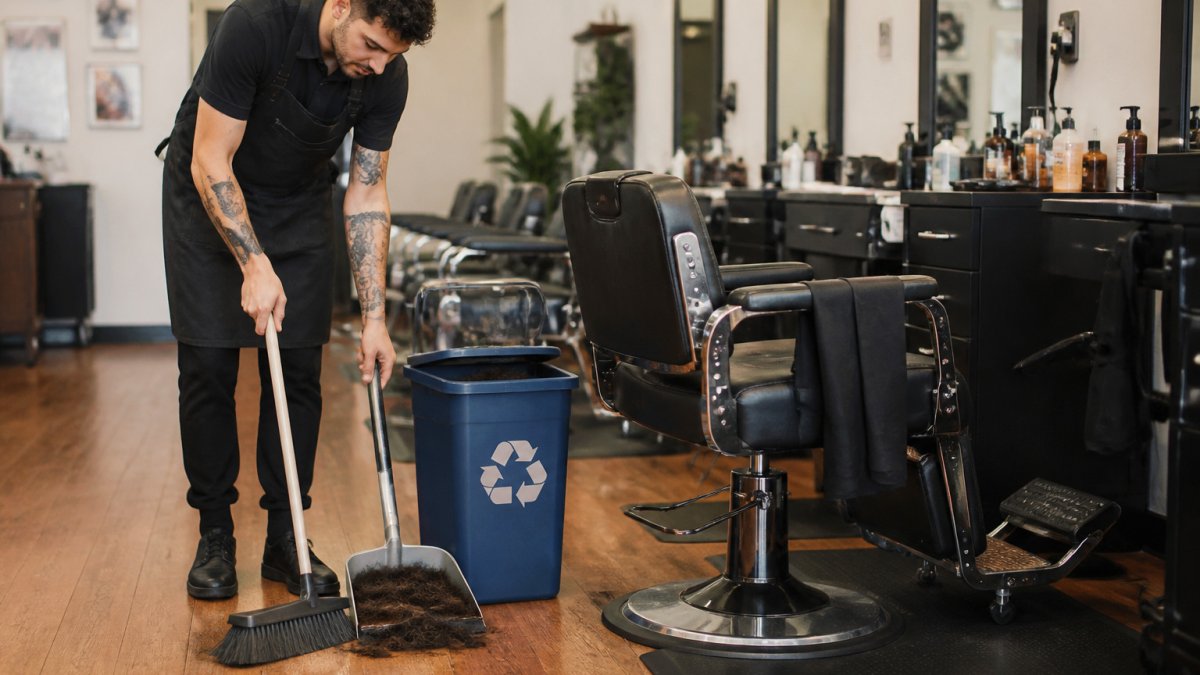
Packaging is easier. Set up a clearly labeled bin for cardboard, paper, and rigid plastic. Flatten boxes before you put them in. Rinse containers when you can.
A neck duster and cape can also cut waste on the floor. Reusable tools and clipper cleaning brushes help you keep equipment working longer, which means fewer replacements.
Simple setup for recycling:
- One bin for hair clippings, lined with a compostable bag
- One bin for cardboard and paper
- One bin for rigid plastic and metal cans
- Clear labels on every bin, in plain words
- A weekly check to make sure bins stay sorted
Step 3: Handle Sharps Disposal for Barbers Safely
Used blades and razor heads should never go in the regular trash. They can injure staff and the people who handle your garbage. Use a sealed sharps container, sized to your volume, and replace it when it is three-quarters full.
Wear gloves when you handle sharps. Disposable nitrile gloves protect hands during cleanup and container changes. Keep a box near the sharps bin so staff never have to search for them.
Check your state and local rules for how sharps containers must be disposed of. Requirements vary by location, so confirm them with your waste hauler or local health department before you set a schedule.
Step 4: Manage Chemicals, Aerosols, and Color Waste
Chemical waste is where eco friendly waste disposal for barber shops gets legally serious. Hair color, developer, bleach, relaxers, keratin treatments, and solvent-based cleaners can carry ignitable, corrosive, or toxic properties. Chemical waste from a barber shop may be regulated under federal and state hazardous waste rules, and the requirements depend on how much waste your shop generates each month.
First, classify what you actually have. Read the Safety Data Sheet (SDS) for every chemical you stock, your distributor must provide one, and it lists the hazard statements and disposal codes. Hazardous waste is generally defined by characteristics such as ignitability, corrosivity, reactivity, and toxicity under federal and state rules (the EPA).
Then build a compliant storage and labeling routine:
- Keep chemicals in a locked, ventilated cabinet away from heat, sunlight, and clipper sanitizers.
- Label every secondary container with the product name and hazard, not just 'color.'
- Keep SDS binders (paper or digital) where staff can reach them in an emergency.
- Store oxidizers like developer separately from solvents and aerosols.
- Use a secondary containment tray under liquid chemicals to catch drips.
Disposal mechanics that actually work for a small shop:
- Empty aerosol cans: Once the can is fully depressurized and empty, many municipal recycling programs accept it as scrap metal. Confirm with your hauler, some curbside programs reject aerosols outright.
- Leftover color and developer: Do not pour down the drain. Collect in a labeled, closed container and take it to an HHW facility or a licensed pickup. Many counties run monthly small-business HHW days; check your state environmental agency's HHW locator.
- Color tubes and foil packets: These are usually not recyclable curbside because of mixed materials and residue. Treat them as hazardous if they contain unused product; otherwise follow local guidance.
- Solvent-based cleaning products: These are often ignitable. Keep them out of regular trash and out of drains.
A practical compliance check you can run this week:
- Pull the SDS for every chemical on your shelf and note the disposal section.
- Call your state environmental agency or county HHW program and ask two questions: Do you accept small-business hazardous waste, and what are the drop-off limits?
- Ask your waste hauler whether they offer a small-quantity hazardous waste pickup and what the minimum volume is.
- Post a one-page 'what goes where' sheet next to the chemical cabinet.
This is the part of eco friendly waste disposal for barber shops that most guides skip. Getting it right protects your staff, keeps you out of trouble with your state environmental agency, and often costs less than owners expect because small shops qualify for HHW programs designed for households and small businesses.
Building Sustainable Barber Shop Practices and Staff Habits
A waste plan lives or dies with the people running the chairs. Most guides tell you to 'train your team' and stop there. Here is the missing piece: a concrete onboarding and accountability system that fits a small barbershop, plus the cost math that makes staff care.
Start with a 20-minute onboarding module. Every new barber, apprentice, and front-desk hire should get the same short walkthrough before their first shift on the floor:
- A physical tour of every bin, with the 'what goes where' sheet posted above each one.
- A two-minute demo of sharps handling and glove use.
- A quick explanation of why it matters, lower supply costs, fewer injuries, and clients who notice.
- A signed one-page acknowledgment kept in their file.
Make it a habit, not a poster. The shops that keep sorting right use three lightweight mechanisms:
- A weekly two-minute huddle. Pick one stream per week, hair, packaging, sharps, or chemicals, and do a quick bin check together. Rotate who leads it so ownership spreads.
- A monthly waste walk. Once a month, the manager and one staff member walk the bins and note contamination (hair in recycling, gloves in compost). Post the result on a small whiteboard.
- A quarterly numbers review. Track two numbers only: how many trash bags you pull per week and how many recycling pickups you schedule. If trash bags drop, the plan is working.
The cost-benefit math for a small shop. You do not need a consultant to see the return. A typical barbershop buys trash bags, pays for dumpster pickup, and replaces clipper blades and capes on a schedule.
Give staff a reason to care that is not abstract. Tie the plan to things they feel: a tidier station, fewer nicks from loose blades, and a shop that clients compliment.
Common staff pushback and how to answer it:
- 'This slows me down.' Show them the bin layout, if bins are within arm's reach of each station, sorting adds seconds, not minutes.
- 'I don't know where this goes.' The posted sheet and the weekly huddle answer it. If a item is genuinely ambiguous, the captain decides and updates the sheet.
- 'The owner just wants to look green.' Share the quarterly numbers. When staff see trash bags drop and supply costs fall, the plan stops feeling like optics.
This is the part of eco friendly waste disposal for barber shops that competitors leave out: a repeatable training loop and a simple ROI story that turns a policy into a habit.
Start Your Waste Audit This Week
You do not need to fix everything at once. Start with the audit this week. Track what you throw away, then set up one new bin for your biggest stream.
Once the basics are running, add sharps handling and chemical storage. Each step makes your shop cleaner, safer, and more efficient. Begin today, and keep building from there.
Frequently Asked Questions
What is the most eco-friendly way to dispose of hair clippings?
The most practical option is to collect clippings in a dedicated bin, let them dry, and send them to a compost program that accepts hair, or use them as a mulch or soil amendment where local rules allow. Hair breaks down slowly, so avoid mixing it with wet food waste. Keeping clippings separate from general trash also cuts landfill volume and makes it easier to track how much waste your shop produces each month. Check with your local waste hauler before composting, since some municipal programs have specific rules.
How do I properly dispose of used razor blades in a shop?
Used razor blades should never go into regular trash or recycling bins. Place them in an FDA-cleared sharps container, which is sold at most pharmacies and medical supply retailers, and seal it when it reaches the fill line. Many cities and states have sharps drop-off or mail-back programs for small generators. Keep the container out of reach of children and staff, and replace it on schedule rather than overfilling it. Follow your state's medical waste rules, since requirements vary by location.
How can barber shops reduce plastic waste from product packaging?
Start by buying concentrated products and larger refill sizes where they are available, since fewer containers mean less packaging. Ask suppliers whether they take back empty bottles or offer refill programs. Rinse and recycle clean bottles according to your local rules, and avoid single-use plastic cups and wrappers in the waiting area. Tracking which products create the most packaging waste during your audit will show you where a switch makes the biggest difference.
Is it possible for a barber shop to achieve zero-waste status?
A barber shop can get very close to zero waste to landfill, but full zero waste usually requires a third-party certification and a waste hauler that diverts materials. Most shops achieve the practical goal by sorting clippings, metals, foils, paper, and plastics into separate streams and sending sharps and chemicals through proper hazardous or medical disposal channels. Measure your landfill output for a month to see how close you are, then set a realistic target for the next quarter.
