

Table of Contents
- Razor Fade vs Clipper Fade: The Core Difference
- Quick Comparison: Razor Fade vs Clipper Fade
- Skin Fade vs Zero Fade: Where Each Technique Fits
- Skin Sensitivity, Irritation, and Aftercare
- Best Professional Clippers for Skin Fades
- How to Maintain a Skin Fade Between Visits
- Cost-Benefit Analysis: Barber Visits vs. DIY
- Which Fade Should You Choose?
- Frequently Asked Questions
Last Updated: September 7, 2026
Razor Fade vs Clipper Fade: The Core Difference
The razor fade vs clipper fade comparison comes down to one question: do you want a completely bald, skin-tight finish or a soft, blended transition? A razor fade uses a straight razor or foil shaver to remove hair entirely at the base, leaving smooth, visible scalp (the American Academy of Dermatology). A clipper fade relies on staggered tooth clippers and guard sizes to taper hair from short to long, leaving a fine layer of stubble rather than bare skin.
The razor fade vs clipper fade choice affects regrowth appearance within days, skin irritation risk, and how often the client needs to return.
Quick Comparison: Razor Fade vs Clipper Fade
The fastest way to understand the razor fade vs clipper fade difference is to look at the finished result and regrowth. A razor fade delivers a bald finish with zero shadow, while a clipper fade leaves approximately 0.5mm of stubble that creates a softer gradient.
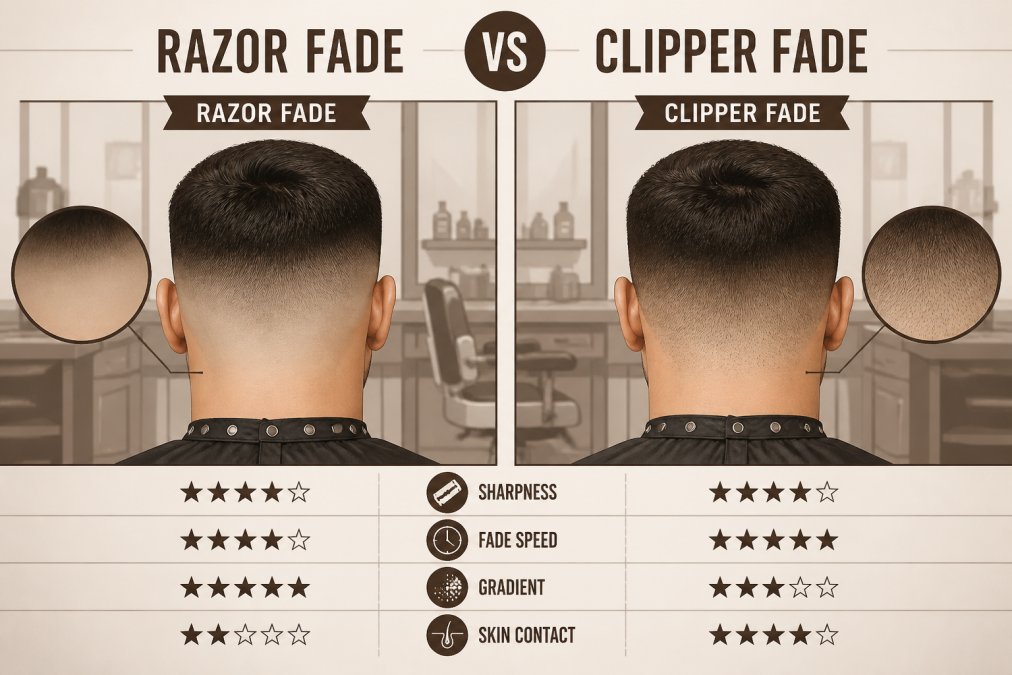
| Feature | Razor Fade | Clipper Fade |
|---|---|---|
| Finish | Bald, smooth scalp | Fine stubble, soft blend |
| Sharpness | Crisp, defined lines | Gradual, natural transition |
| Regrowth visible | 1-2 days | 3-5 days |
| Skin irritation risk | Higher | Lower |
| Maintenance frequency | Every 1-2 weeks | Every 2-3 weeks |
| Best for | Coarse hair, dramatic contrast | Sensitive skin, softer look |
Visual Result: Bald Finish vs. Soft Blend
A razor fade produces the sharpest lines in barbering. The straight razor removes hair at skin level, creating a crisp finish that makes the transition from bald to full hair unmistakable.
A clipper fade builds the fade using clipper-over-comb and guard size progression, creating a natural transition ideal for clients who want a taper without the stark contrast of bare scalp.
Regrowth Timeline and Aesthetics
Razor fades show visible shadow within 24 to 48 hours because the hair follicle is cut flush with the skin, making even minimal growth obvious (peer-reviewed research). Clients with dark, coarse hair notice this fastest.
Clipper fades hold their shape longer. The residual stubble means regrowth blends into the existing fade rather than creating a hard line of contrast, so a clipper fade looks acceptable for longer between visits.
Skin Fade vs Zero Fade: Where Each Technique Fits
A skin fade is a general term describing any fade that tapers down to the skin or near-skin level. A zero fade specifically means the hair is removed completely to bald using a razor or foil shaver, creating that polished, scalp-visible finish.
Zero fades deliver maximum sharpness and are popular for modern, high-contrast styles. Skin fades that stop at a very short clipper length offer a similar silhouette with less maintenance pressure and reduced irritation risk.
Skin Sensitivity, Irritation, and Aftercare
Razor fades carry a higher risk of razor burn, ingrown hairs, and scalp irritation because the blade removes the top layer of dead skin cells along with the hair (the CDC). Clients with sensitive skin, acne, or a history of folliculitis should approach zero fades with caution.
Clipper fades are gentler on the scalp. The blade never contacts the skin directly at zero gap, so irritation is minimal. For clients who experience razor burn easily, a clipper fade at the lowest guard setting achieves a nearly identical look without the aftercare burden.
Recommend a cooling aftershave balm for razor fades and a lightweight moisturizer for clipper fades. Clients should avoid tight collars and heavy sweating for 24 hours after a razor fade to prevent friction irritation.
Best Professional Clippers for Skin Fades
Executing a clean clipper fade requires equipment that holds a zero-gap adjustment and maintains consistent power through dense hair. The best professional clippers for skin fades combine blade precision with motor reliability.
The Wahl 5-Star Vapor™ Clipper at $200.99 stands out for fade work. Its F32 FADEOUT™ blade features 32 fine ball-point teeth designed for seamless balding and close fading. The high-speed brushless motor delivers 8,000 RPMs with Adaptive Speed Control, handling all hair textures without bogging down. The zero-gap adjustable blade achieves an ultra-close cut that approaches razor-level finish while remaining gentler on the skin.

For barbers who want a dedicated fade machine at a lower price point, the Wahl 5 Star Cordless Senior Clipper at $164.99 uses the classic 2191 blade with zero-overlap adjustment. Its rotary motor powers through thick hair, and the 70-minute runtime covers a full day of clients. The Wahl Professional 5-Star Senior 2.0 Cordless Clipper at $229.95 adds Adaptive Speed Control™ and USB-C charging for barbers who want the latest motor technology.


| Clipper | Price | Key Feature | Best For |
|---|---|---|---|
| Wahl 5-Star Vapor™ | $200.99 | F32 FADEOUT™ blade, 8,000 RPM | Seamless balding, close fades |
| Wahl 5 Star Cordless Senior | $164.99 | 2191 zero-overlap blade | Classic precision fades |
| Wahl Senior 2.0 Cordless | $229.95 | Adaptive Speed Control™ | High-volume daily use |
| Wahl Cordless Legend | $144.99 | Wedge blade, 100-min runtime | Versatile fade work |
| Wahl Black Magic Clip | $139.99 | Stagger-Tooth™ blade | Crisp fades with auditory feedback |
All of these Wahl models are Certified Clippers available through Fade Supply Co, which stocks professional-grade tools selected based on real-world experience behind the chair.
How to Maintain a Skin Fade Between Visits
The razor fade vs clipper fade decision is really a decision about what you are willing to do on day six, day ten, and day fourteen after the cut. The two fades age completely differently, and the maintenance routine is not optional, it is the difference between a style that looks intentional and one that looks neglected.
The 1-Week Mark: The Divergence Point
At day seven, a razor fade has lost its defining feature. Because the hair was cut flush with the skin, the regrowth appears as a uniform, dark shadow across the entire faded zone. By day seven, the contrast between the shadowed base and the longer hair above creates a hard line that reads as 'overgrown,' not 'faded.' The only fix is a foil shaver or a straight razor pass over the base.
A clipper fade at day seven looks nearly identical to how it looked on day one. The residual 0.5mm of stubble means the regrowth is incremental and uniform, so the client can comfortably stretch to day ten or day twelve before the transition starts to look muddy.
The 2-Week Mark: The Awkward Phase
By day fourteen, a razor fade requires a full reset, the bald area has grown to roughly 1.5mm to 2mm, and the original sharp line has softened into a fuzzy band. Attempting to 'touch up' just the neckline with a trimmer will not work; the entire faded zone needs to be reshaved to restore the crisp edge.
A clipper fade at day fourteen is approaching its limit but is still presentable. The nape and sideburn edges will need a clean-up, but the blended mid-section holds its shape. A home trimmer with a #1 or #1.5 guard can refresh the neckline and sideburns in under five minutes.
The Home Maintenance Kit: What Actually Works
For razor fade clients, the home kit is non-negotiable. A foil shaver, not a rotary shaver, is the right tool because foils cut closer to the skin and handle the contours of the nape and behind the ears without nicking. The Andis ProFoil Lithium Plus or the Wahl Finale are the standard choices behind the chair. The client must shave the faded zone every two to three days to maintain the bald base so the contrast stays sharp.
For clipper fade clients, the home kit is simpler: a trimmer with adjustable guards and a handheld mirror. The goal is not to recreate the fade but to maintain the perimeter. Cleaning up the neckline, the sideburns, and the area just above the ears every four to five days keeps the cut looking fresh.
The Real Maintenance Schedule
The honest schedule, based on how hair actually grows, is this:
- Razor fade: Full barber visit every 10 to 14 days. Home foil shaving every 2 to 3 days to keep the base bald. No version of home maintenance replaces the barber visit because the transition line needs professional blending.
- Clipper fade: Full barber visit every 3 to 4 weeks. Home perimeter clean-up every 4 to 5 days. The mid-section requires no home work.
For barbers, the consultation should include a maintenance conversation, not just a style conversation. Ask the client how often they are willing to maintain the cut at home; the answer should determine whether you reach for the straight razor or the clippers.
Cost-Benefit Analysis: Barber Visits vs. DIY
The razor fade vs clipper fade decision has a real financial dimension. The cost difference is not just the price of the cut, it is the frequency of the cut, the cost of home tools, and the risk of a DIY mistake that requires a professional fix.
The Real Cost of a Razor Fade
A professional razor fade at a mid-tier barbershop in a U.S. metropolitan area typically runs between $35 and $60. The critical factor is frequency: a razor fade requires a visit every 10 to 14 days to maintain the bald finish. At the 14-day end, that is 26 visits per year; at the 10-day end, it is 36 visits.
At $40 per visit with a 14-day cycle, the annual cost is $1,040. At $50 per visit with a 10-day cycle, the annual cost is $1,800. Add a $2 to $5 tip per visit, and the real range is roughly $1,100 to $2,000 per year.
The Real Cost of a Clipper Fade
A clipper fade at the same barbershop runs the same $35 to $60 per visit, but the frequency drops to every three to four weeks. At the three-week end, that is 17 visits per year. At the four-week end, it is 13 visits.
At $40 per visit with a three-week cycle, the annual cost is $680. At $50 per visit with a four-week cycle, the annual cost is $650. The clipper fade costs roughly 40% to 60% less per year than the razor fade, purely because of visit frequency.
The DIY Math: What the Tools Actually Cost
For clipper fades, DIY is a realistic option for a competent individual. A professional-grade clipper like the Wahl 5 Star Cordless Senior at $164.99 or the Wahl Cordless Legend at $144.99 is a one-time purchase. Add a $20 mirror setup and $10 for a cape, and the total home investment is roughly $175 to $195.
If that client would otherwise spend $680 per year on professional clipper fades, the clipper pays for itself after approximately three to four visits. The caveat is skill: achieving a seamless blend on the back of your own head requires practice. A realistic hybrid model is a professional fade every six weeks ($325 to $450 per year) with home perimeter touch-ups between visits.
For razor fades, DIY is a different story. A straight razor kit with quality blades, strop, and shaving cream runs $80 to $150, but the skill required to shave the nape and the area behind the ears on your own head is substantially higher than using clippers. A slip with a straight razor near the ear or the cervical spine can cause a cut that requires medical attention.
A safer DIY option for maintaining a razor fade at home is a foil shaver, which runs $60 to $120 for a quality model like the Andis ProFoil or Wahl Finale. But the foil shaver only maintains the bald base, it does not recreate the transition line.
The Hidden Cost of a Bad DIY Fade
There is also the cost of fixing a mistake. A botched DIY fade, whether from a clipper that jumped or a razor that slipped, requires an emergency barber visit to correct. That visit typically costs the same as a regular cut, but it happens on short notice and often at a premium shop.
For barbers, this analysis is a useful consultation tool. When a client asks for a razor fade but hesitates at the price, lay out the annual cost difference. Many clients will choose the clipper fade once they understand the 10-to-14-day revisit requirement is not a suggestion.
Which Fade Should You Choose?
The razor fade vs clipper fade choice ultimately depends on three factors: skin sensitivity, maintenance tolerance, and desired aesthetic. Choose a razor fade for clients who want maximum sharpness, have resilient skin, and commit to weekly or biweekly maintenance. Choose a clipper fade for clients with sensitive skin, busy schedules, or a preference for softer blending.
For barbers building their fade repertoire, mastering both techniques is essential. The best professional clippers for skin fades, like the Wahl 5-Star Vapor™ with its F32 FADEOUT™ blade, bridge the gap by delivering razor-close results with the safety and consistency of a clipper.
Choosing between a razor fade and clipper fade is about matching the technique to the client's skin, hair texture, and grooming habits. Fade Supply Co supports barbers with professional-grade tools and station essentials that perform reliably in high-volume environments. Shop Collection at Fade Supply Co and stock your station with equipment that delivers crisp finishes every time.
Frequently Asked Questions
What is the main difference between a razor fade and a clipper fade?
The difference is the finish. A razor fade uses a straight razor or foil shaver to remove hair completely, leaving a bald finish with skin visible. A clipper fade uses a clipper with a staggered tooth blade to cut hair close, leaving a fine layer of stubble. This makes the clipper fade look softer and less stark than a razor's crisp, sharp line.
Which fade technique provides a closer shave?
A razor fade provides the closest shave, cutting hair below the skin's surface for a completely smooth, bald finish. Clippers leave a tiny amount of stubble because the blade cannot cut as close. If your client wants scalp visibility and sharp lines, a razor is the choice. For a softer look, a clipper is better.
How does the longevity of a razor fade compare to a clipper fade?
A razor fade lasts about 3 to 5 days before stubble appears, requiring more frequent maintenance. A clipper fade lasts longer visually because the short stubble blends with the hair growth cycle, so the cut looks fresh for up to 2 weeks. If your client wants a low-maintenance option, the clipper fade is more practical.
Are razor fades suitable for all hair types?
Razor fades work on most hair types, but they are best for clients with straight or coarse hair. Curly or tightly coiled hair can be prone to razor bumps and ingrown hairs when shaved to the skin. In these cases, a clipper fade with a foil shaver is a safer choice to minimize skin irritation.
What is the best clipper for a skin fade?
The Wahl 5-Star Vapor Clipper is a top pick for skin fades. Its F32 FADEOUT™ blade is designed for seamless balding and close fading. It also offers cordless flexibility, which is useful for detailing the hairline and neckline.