

Table of Contents
- Best Professional Barber Shears at a Glance
- Percu Pro Barber Cut Line Shears: Built for Barber Technique
- Percu Barber Slim Cut Line Hair Shear: Precision for Detail Work
- Percu Ziggy Line Hair Shear 6": Ergonomic Control for Extended Sessions
- Japanese Steel Barber Shears: Why Material Matters
- Barber Shear Sizes and Blade Lengths: Finding Your Fit
- Texturizing Shears for Barbers: Volume and Depth
- Barber Shears Maintenance and Sharpening
- Frequently Asked Questions
Last Updated: October 21, 2026
Best Professional Barber Shears at a Glance
The right professional barber shears make the difference between rushed, uneven cuts and the clean lines that build your reputation. At Fade Supply Co, we know the wrong tool slows you down and undermines your technique. Whether you're working scissor-over-comb fades, point cutting, or slide cutting, blade quality, handle ergonomics, and steel composition directly impact speed and precision.
This guide covers the professional barber shears that earn their place in working shops, built for barber technique, not generic haircutting scissors, across price points, blade styles, and hand sizes.
| Shear Model | Price | Best For | Key Feature |
|---|---|---|---|
| Percu Pro Barber Cut Line | $49.99 | Barbers seeking versatile technique range | Convex and razor convex blades, 5.5"-8" sizes |
| Percu Barber Slim Cut Line | $79.99 | Detail and precision work | Ultra-thin blades, 60 HRC hardness |
| Percu Ziggy Line 6" | $79.99 | Extended sessions with ergonomic control | Off-set grip, fixed finger rest |
| Percu Virtual Line | $49.99 | Sliding cuts and voluminous styles | 58 HRC hardness, multiple sizes |
| Percu Fantastica Line | $79.99 | Texturizing and bulk removal | 60 HRC hardness, black titanium finish |
Percu Pro Barber Cut Line Shears: Built for Barber Technique
The Percu Pro Barber Cut Line Shears are engineered for professional barbers, not salon stylists.

Available in 5.5" to 8" sizes, they adapt to different hands and cutting preferences. A finger rest and adjustable screw give tension control when switching between tight scissor-over-comb work and looser slide cutting. The polish finish resists corrosion.
What sets these apart is versatility: the blade geometry works for both precision and volume removal. At $49.99, they're a solid backup pair for experienced barbers.
Percu Barber Slim Cut Line Hair Shear: Precision for Detail Work
The Percu Barber Slim Cut Line Hair Shear is built for barbers who prioritize precision over speed. Ultra-thin, razor-sharp blades cut with minimal resistance for crisp fade lines and shape-up detail. Premium Japanese 440 stainless steel at 60 HRC keeps them sharp longer than lower-grade steel.

Available in 5.5" and 6" sizes, they're designed for control in tight spaces. The ergonomic grip reduces hand fatigue, the removable finger rest adds flexibility, and the flat adjustable screw lets you dial in precise tension, critical with thin blades that demand consistency.
At $79.99, the investment pays off if detail work is your specialty.
Percu Ziggy Line Hair Shear 6": Ergonomic Control for Extended Sessions
The Percu Ziggy Line Hair Shear 6" is engineered for barbers working long shifts. The off-set ergonomic grip reduces wrist strain during hours of repetitive cutting.
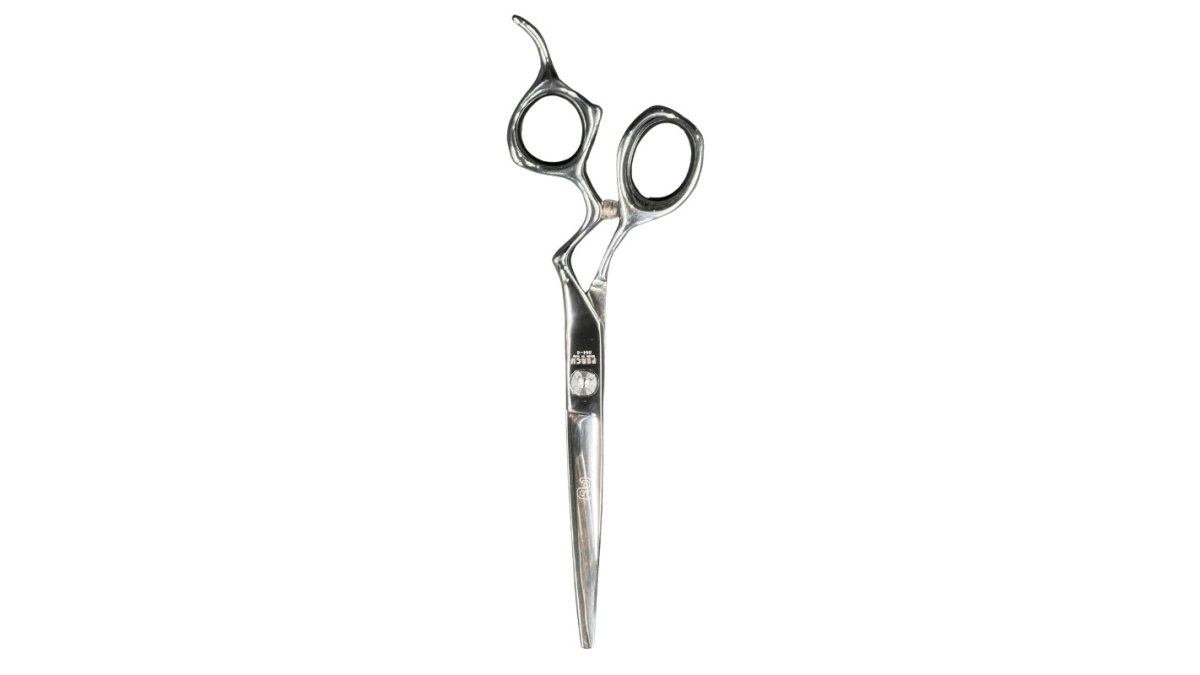
The fixed finger rest adds stability during scissor-over-comb work, and the flat adjustable screw gives precise tension control. At 6", it suits most barbers across fade work, bulk removal, and detail cutting, and the polished finish resists corrosion.
At $79.99, this mid-range option prioritizes comfort without sacrificing performance.
Japanese Steel Barber Shears: Why Material Matters
Japanese stainless steel, particularly 440 and higher grades, dominates professional barber shears because composition determines edge retention, corrosion resistance, and how long your shears stay sharp between sharpenings. Some Percu barber shears use Japanese 440, which balances hardness and durability.
Steel hardness is measured in HRC (Rockwell Hardness), and barber shears typically range from 58 to 60 HRC.
AISI 420 stainless steel, used in some Percu lines, offers good corrosion resistance and decent edge retention at a lower price. It's more durable and easier to sharpen.
Barber Shear Sizes and Blade Lengths: Finding Your Fit
Most shear guides stop at "small for detail, large for bulk." That's incomplete, fit combines four variables: blade length, handle type, tension, and handedness. Getting three of four right still leaves you with a shear that slows you down.
Blade length: match the length to the work, not the trend
Blade length is measured from the pivot to the tip of the cutting blade. The practical ranges for barbering:
- 5"-5.5", Maximum control for tight scissor-over-comb passes, point cutting, and detail around the ears and neckline. Slower for bulk removal; more strokes per section.
- 6"-6.5", The working barber's default. Handles fade work, cross-checking, and moderate bulk removal without constant tool swaps.
- 7"-8", Fast through length and bulk, but harder to control in tight spaces. Usually a second or third pair for barbers doing a lot of longer-hair work or heavy bulk removal.
Rule of thumb: the tighter your fade work, the shorter the blade.
Handle types: offset, classic, and what they do to your wrist
Handle design changes your wrist angle through the cut, over an eight-hour day, that matters more than any single blade feature.
- Offset handle, The thumb ring sits lower than the finger ring, dropping your wrist into a more neutral position. This is the most common choice for barbers doing repetitive scissor-over-comb and fade work, and it's the design behind the Percu Ziggy Line's ergonomic pitch.
- Classic/straight handle, Thumb and finger rings align. Familiar to barbers trained on traditional shears.
- Swivel thumb, The thumb ring rotates independently, reducing thumb strain during point cutting and slide cutting.
Tension: the setting most barbers never adjust
The tension screw controls how freely the blades close. Too loose and the blades push hair instead of cutting; too tight and the shear binds, skips, and tires your thumb.
The standard test: hold the shear tip-up and let the top blade fall. A properly tensioned shear should close most of the way under its own weight but not snap shut. Adjust in quarter-turns and re-test. Recheck tension weekly, it drifts with use and after sharpening.
Handedness: left-handed shears are not a mirror image
Left-handed barbers cannot simply flip a right-handed shear: the blade set is mirrored so the cutting blade sits on the correct side. Buy left-handed shears, most professional lines, including the Percu lines here, offer them, but confirm the specific model and size before ordering since left-handed inventory is thinner.
Sizing to your hand, not the spec sheet
Before buying, check three things:
- Finger hole fit, Your ring finger should sit in the finger ring without pinching or sliding. Too large and you'll grip harder; too small and you'll get pressure points.
- Thumb reach, With the shear closed, your thumb should rest in the thumb ring without stretching or bunching. If you have to reach, the shear is too long for your hand regardless of blade size.
- Pinky rest, The finger rest (fixed or removable) should support your pinky without forcing your hand open.
Texturizing Shears for Barbers: Volume and Depth
Texturizing shears remove bulk while creating movement and depth.
The Percu Fantastica Line Professional Shears are designed for texturizing work. With 60 HRC hardness and Japanese 440 stainless steel, they maintain edge retention through repeated passes.

Texturizing shears work best paired with straight-edge shears: use the texturizers to add depth and remove bulk, then switch to straight-edge shears for clean lines and shape definition.
At $79.99, the Percu Fantastica Line is a solid investment if texturizing is part of your regular work.
Barber Shears Maintenance and Sharpening
A shear's purchase price is only the first cost. What matters over a career is total cost of ownership: purchase price plus sharpening, supplies, repairs, and replacement timing. Here's how to compare a $49.99 shear against a $79.99 shear on real lifetime cost.
Sharpening intervals: volume drives the schedule
There's no universal interval, but the pattern most working barbers follow is tied to cutting volume:
- High-volume shop (roughly 15+ cuts a day), Sharpen every 4-6 weeks.
- Moderate volume (roughly 8-14 cuts a day), Every 6-8 weeks.
- Part-time or low volume, Every 8-12 weeks, or when you notice the shear pushing rather than cutting.
The reliable signal isn't the calendar, it's performance. If you're squeezing harder, seeing crushed ends, or the shear skips on scissor-over-comb passes, it's due.
What sharpening actually costs
Professional sharpening is priced per pair and varies by region, blade type, and whether it includes re-tensioning and alignment. Convex and razor convex edges, used on most professional barber shears, including the Percu lines, require a sharpener who understands that geometry, because a general knife sharpener can change the bevel angle and ruin the cutting feel. Budget for it as a recurring operating cost.
To compare shears, divide purchase price by the number of sharpenings the blade can take before replacement, then add per-sharpening cost.
Daily and weekly maintenance that protects the edge
- After every shift, Brush hair and product residue out of the pivot area with a soft brush, then wipe the blades with a dry soft cloth.
- Weekly, Check and adjust tension (see the sizing section for the drop test). Apply a drop of shear-specific lubricating oil at the pivot, open and close a few times, and wipe off excess.
- Storage, Keep shears in a protective case or holster. Never let them rattle loose in a drawer or bag against clippers and combs; edge-to-edge contact is how chips happen.
- Handling, Don't cut anything but hair. Foil, tape, tags, and paper will roll or chip a fine edge instantly.
Warranty, repair, and when to replace
Warranty terms vary by manufacturer, so read the terms for the model you buy. Most cover manufacturing defects, pivot failure, handle defects, and exclude wear, drops, chips, and improper sharpening. Keep your purchase record.
Repair is usually limited to re-tensioning, realignment, and re-sharpening. Replace a shear when it won't hold an edge after sharpening, the blades no longer align at the pivot, or a chip sits in the cutting zone.
The ownership math in practice
Run the numbers for your volume: purchase price, sharpenings per year, cost per sharpening, and expected years of service.
Frequently Asked Questions
What makes professional barber shears different from regular hair-cutting scissors?
Professional barber shears are engineered for specific barbering techniques like scissor-over-comb, fade work, and point cutting. They feature convex or razor-convex blades hardened to 58-60 HRC for sustained edge retention, offset or ergonomic handles to reduce hand fatigue during high-volume work, and adjustable tension screws for precise control. Consumer scissors lack the blade hardness and handle design needed for 8+ hours of daily professional use.
Are Japanese steel barber shears worth the investment?
Japanese steel barber shears, particularly AISI 420 and 440 stainless steel, hold their edge longer and resist corrosion better than lower-grade alternatives. Blades hardened to 60 HRC (common in Japanese-crafted shears) maintain sharpness through hundreds of cuts before requiring professional sharpening.
What size professional barber shears should I choose?
Blade length ranges from 5 inches to 8 inches. Most barbers use 5.5" to 6.5" for general cutting, fades, and detail work. Larger sizes (7"-8") work better for bulk removal and longer hair. Your hand size and cutting technique matter most, test multiple sizes before committing.
How often should professional barber shears be sharpened?
Frequency depends on hair type (coarse hair dulls blades faster), cutting technique, and maintenance.
What's the price range for professional barber shears in 2026?
Professional-grade barber shears range from $49.99 to $79.99 for Italian-crafted, Japanese steel options at Fade Supply Co. Premium models at $70-$80 offer higher blade hardness (60 HRC).
Selecting the right professional barber shears means matching blade style, size, and steel quality to your technique and hand size. The Percu lines from Fade Supply Co offer reliable options across different price points and specializations. Whether you're starting your barbering career or upgrading after years of use, investing in quality shears pays dividends in speed, precision, and comfort.
Shop our collection of professional barber shears and find the right tool for your craft.