

Table of Contents
- How Long Do Professional Barber Shears Last? Realistic Estimates
- How Often to Sharpen Barber Shears (and What Sharpening Costs)
- How to Clean and Oil Hair Shears: A Daily and Weekly Routine
- Signs Barber Shears Need Sharpening or Service
- When to Replace Hair Cutting Scissors (and When to Repair)
- Lifespan by Shear Type and Total Cost of Ownership
- Frequently Asked Questions
Last Updated: October 19, 2026
How Long Do Professional Barber Shears Last? Realistic Estimates
Most professional barber shears last three to five years in a busy shop, and five to seven years or more for part-time or student use, assuming quality steel, regular sharpening, and daily care.
Shear lifespan is the working life of a pair of haircutting scissors before blade wear, alignment loss, or damage makes performance unacceptable. Steel quality, cutting volume, and care habits decide where a pair lands.
The variables that matter most:
- Steel and edge type. Japanese 440C and AISI 440 stainless hold an edge longer than softer alloys.
- Daily cutting volume. A barber doing 20 cuts a day wears an edge faster than one doing five.
- Sharpening discipline. Skipping sharpening until shears snag forces a shop to remove more metal at once.
Lifespan by Usage Intensity and Shear Quality
A high-volume shop with eight chairs running six days a week is the hardest test a shear faces. There, a working edge needs attention far more often than a part-time barber's.
| Usage Level | Typical Cutting Load | Entry-Level Shear | Professional-Grade Shear |
|---|---|---|---|
| Student / apprentice | A few cuts per week | 1-2 years | 3-4 years |
| Part-time barber | 5-10 cuts per day | 1.5-2.5 years | 4-6 years |
| Full-time barber | 15-25 cuts per day | 1-2 years | 3-5 years |
| High-volume shop chair | 25+ cuts per day | Under 1 year | 2-3 years |
The pattern is simple: cheap steel in a heavy chair is a false economy. Premium stainless steel with a hardened edge stays sharp longer and survives more sharpening cycles.
How Often to Sharpen Barber Shears (and What Sharpening Costs)
Professional sharpening is typically needed every 400 to 600 cuts, roughly every four to eight weeks for a full-time barber, every three to four months part-time, and monthly for high-volume chairs. What matters for lifespan is not how often you sharpen but how much steel each sharpening removes.
How often to sharpen barber shears depends on three signals: how the shear feels, how it sounds, and how it cuts.
What Professional Sharpening Actually Costs
Sharpening is priced per pair and varies by edge geometry, steel, and whether the service includes tension and alignment work. Convex edges cost more because they require a trained sharpener and a different honing process; a bevel edge can be restored on standard equipment.
Barbers who sharpen on a fixed schedule spend less per year than those who wait for failure. Scheduled light honing removes less metal per service and keeps blade width in the safe zone longer.
What to expect from professional sharpening:
- A reputable sharpener inspects the cutting edge and blade under magnification before touching the shear.
- Convex edge shears need a sharpener trained on convex geometry. A bevel edge can be restored differently.
- Most shops charge per pair, and pricing varies by region and edge type. Ask for a quote before handing over your shears.
How Sharpening Frequency Shortens or Extends Lifespan
Every sharpening removes a small amount of steel, the question is whether that removal is planned and minimal or reactive and heavy.
Track two things: the date of each sharpening and the sharpener's note on remaining blade width. When the width nears the point where the blade will not hold an edge, the shear is near replacement regardless of how it feels.
How to Clean and Oil Hair Shears: A Daily and Weekly Routine
Daily care is the cheapest way to extend shear lifespan, and it takes about two minutes: wipe, brush, dry, oil, store.
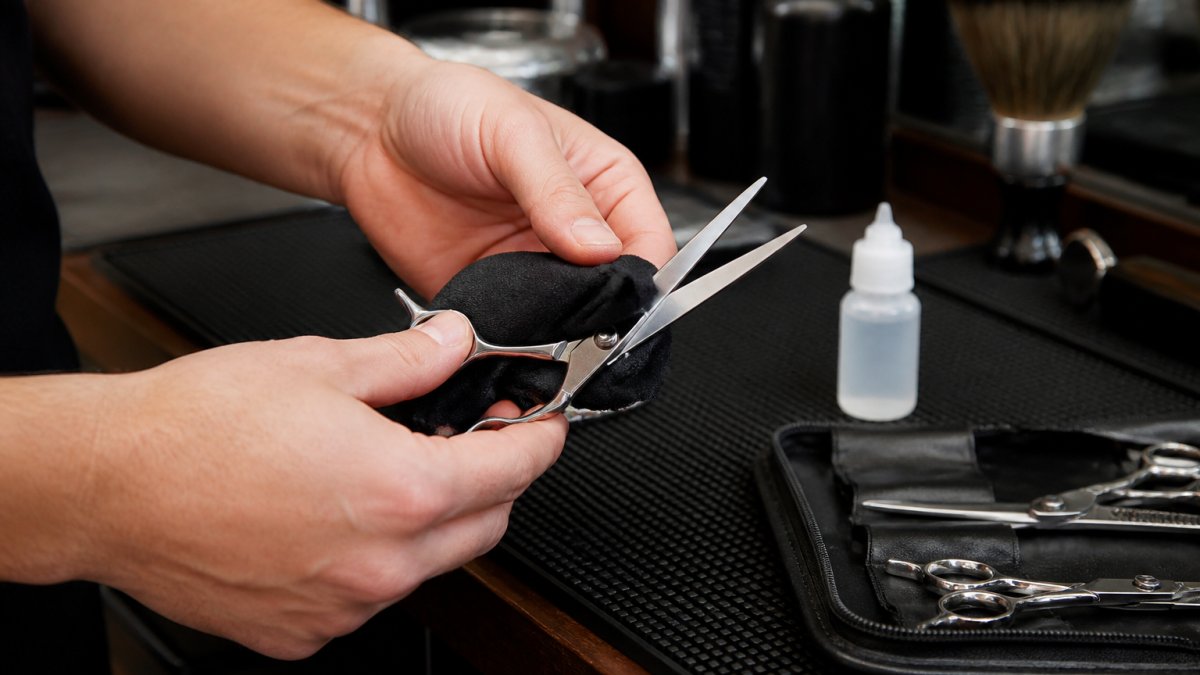
How to clean and oil hair shears properly:
- Remove hair and debris. Brush clippings from between the blades after every client. Hair traps moisture and grit.
- Wipe the blades. Use a soft cloth with a drop of shear oil. Wipe along the blade, never across the edge.
- Disinfect between clients. Follow your state board's rules for tool sanitation. Wipe disinfectant off fully before oiling.
- Dry completely. Moisture left on stainless steel invites corrosion and dulls the edge.
- Oil the pivot. One drop of shear oil at the pivot screw, then open and close the shears a few times.
- Check tension. Hold the shear tip up and let the top blade fall. It should close smoothly, not fall open or stick.
Drying, Tension Checks, and Safe Storage
Tension adjustment is the most overlooked maintenance task. A pivot that is too tight grinds the blades together. One that is too loose lets them separate and fold hair instead of cutting it.
Storage protects everything the routine above preserves:
- Keep shears in a protective case or holster, never loose in a drawer.
- Never let shears rest on a counter where they can be knocked off.
- Store shears closed and dry, away from clipper spray and moisture.
Signs Barber Shears Need Sharpening or Service
Signs barber shears need sharpening show up in the cut before they show up on the blade:
- Snagging or pulling hair instead of slicing it.
- Folding hair between the blades rather than cutting clean.
- Pushing hair down the blade during a slide cut.
Any one of these means book service. Two or more means stop using the shear on clients.
When to Replace Hair Cutting Scissors (and When to Repair)
Replacement becomes the right call when repair costs approach the price of a new shear, or when the blade has lost too much metal to sharpen again. A good sharpener will tell you when a shear is at the end of its life. Ask directly.
When to replace hair cutting scissors comes down to four checks:
- Metal loss. If repeated sharpening has thinned the blade, the edge will not hold.
- Alignment damage. A bent blade from a drop is sometimes fixable, sometimes not.
- Pivot wear. A pivot that will not hold tension after adjustment is failing.
Repair vs. Replace: A Simple Decision Guide
Use this framework before you spend money on service:
- Does the shear still have enough blade width to sharpen? If no, replace.
- Is the repair quote well below the price of a comparable new shear? If yes, repair.
- Is the damage a bent blade or a failed pivot? Get a sharpener's opinion first.
Lifespan by Shear Type and Total Cost of Ownership
Different shear types age differently, and the difference is mechanical, not marketing. Cutting shears take the most wear because every cut loads the full blade edge, and shears over comb work puts steady pressure on the edge cut after cut. Thinning shears and texturizing shears spread the load across teeth, so each tooth sees less force and holds its shape longer between sharpenings.
Edge geometry matters too. A convex edge is thinner behind the cutting edge and slices with less push, many barbers prefer it for slide cutting, but it has less supporting steel and needs a convex-trained sharpener. A bevel edge is more robust and easier to restore, but can feel like it pushes hair more as it dulls.
How Each Shear Type Ages
- Cutting shears (bevel edge): Wear shows as pushing and folding. They tolerate more sharpening cycles because the bevel can be re-established, but heavy use still removes steel over time.
- Cutting shears (convex edge): Wear shows as drag and snagging. They cut beautifully when fresh but demand a convex-trained sharpener, and a bad grind shortens life fast.
- Thinning shears: Teeth see less load per cut, so they often go longer between sharpenings. Watch for bent or chipped teeth rather than a dull edge.
Total Cost of Ownership: The Math That Beats Sticker Price
Total cost of ownership changes the replacement decision. A cheap shear replaced every year costs more than a professional-grade pair that lasts four, once you add sharpening, replacement, and downtime.
The cost structure to track:
- Purchase price. The entry ticket.
- Sharpening. Priced per pair, per service. More frequent service on softer steel can erase the savings of a low purchase price.
- Repair. Bent blades, failed pivots, and replaced parts. Repairs are worth it on good steel and rarely worth it on entry-level shears.
To compare: divide purchase price by expected years of use, then add annual sharpening and repair. A shear that costs more up front but lasts twice as long and needs fewer heavy grinds often wins on annualized cost.
Repair vs. Replace: Thresholds That Actually Decide It
Use these thresholds before spending on service:
- Blade width. If repeated sharpening has thinned the blade so the edge will not hold, replace. Ask your sharpener for a remaining-width estimate.
- Repair quote vs. new price. Well below a comparable new shear, repair; approaching it, replace.
- Damage type. A bent blade from a drop is sometimes fixable, sometimes not. A pivot that will not hold tension after adjustment usually means replacement on entry-level shears, repair on professional-grade ones.
Fade Supply Co stocks shears built for that longer arc. The Percu Pro Barber Cut Line Shears use AISI 420 stainless steel with convex and razor convex blades and a 58HRC hardness rating, sized from 5.5 to 8 inches. The Percu Sky Line Shears use AISI 440 stainless steel with an adjustable screw and an ergonomic finger rest. For cutting and thinning in one purchase, the Percu Oblivion Professional Cobalt Shear Set pairs 440C Japanese steel with cobalt.


Frequently Asked Questions
How long should hairdressing scissors last with daily professional use?
With daily use in a busy shop, most professional barber shears hold their edge for 6 to 12 months before needing sharpening, and the blades themselves typically last 3 to 5 years before replacement makes more sense than another service. That range depends on how many cuts you do per week, the steel quality, and how consistently you clean, oil, and store them. Cheaper shears with softer steel wear faster, while cobalt and premium stainless steel models hold up longer under heavy volume.
How often should professional barber shears be sharpened?
A working barber cutting 20 or more clients per week should plan on sharpening every 6 to 9 months. Lower-volume barbers, students, and part-time chair renters can often stretch to 12 months. Watch performance rather than the calendar: if you are snagging, folding hair, or pushing through cuts instead of gliding, book the sharpening early. Sharpening too often removes steel and shortens the blade's life, so let cutting feel guide the schedule.
What signs mean barber shears need sharpening or repair?
The clearest signs are hair folding or bending between the blades instead of cutting cleanly, a snagging sensation mid-cut, visible nicks on the cutting edge, and a pivot that feels loose or grinds. Shears that push hair along the blade rather than slicing it are also telling you the edge is worn. Check tension first: a loose pivot mimics a dull blade. If tightening the screw does not fix the feel, send the shears for professional sharpening or service.
How should you clean and oil barber shears to make them last longer?
Brush hair and debris off the blades after every client, then wipe them with a cloth. Disinfect according to your state board's rules, and dry the shears fully before oiling. Apply a drop of shear oil at the pivot and along the blade once a day, open and close the shears a few times to spread it, then wipe off the excess. Store them in a protective case, never loose in a drawer, and never drop them. This routine is the single biggest factor in how long barber shears last.
Shear lifespan is not luck. It is steel quality, sharpening discipline, and two minutes of daily care, repeated for years. If your current shears are at the end of their run, Fade Supply Co carries professional-grade options built for daily use, with quick shipping to keep your station stocked and dependable tools for students, mobile barbers, and full shops alike. Shop the collection and put a shear on your station that earns its years.