

Table of Contents
- Assess Your Space and Equipment Needs
- Create a Mobile Barber Equipment Checklist
- Design Your Portable Barber Station Layout
- Implement Sanitation Standards for Mobile Barbers
- Mobile Barber Setup Ideas for 2026
- Protect and Transport Your Equipment
- Maintain Your Portable Station for Longevity
- Conclusion
Last Updated: August 25, 2026
Assess Your Space and Equipment Needs
Before building a portable barber station, measure your available space and list every tool you use during a typical service day. A mobile barber working from a car has radically different needs than someone setting up in a client's home. Document your current workflow: which clippers do you reach for most? How many guard sizes do you actually need accessible? A portable station should mirror your real-world routine, not an idealized version.

Weight matters more than most barbers realize. Calculate total equipment weight, then add 20 percent for the case itself. Anything over 40 pounds becomes exhausting during a full day of solo service (osha.gov). This constraint forces prioritization, which makes a portable station efficient.
Consider your work environment. Are you setting up outdoors in humidity or inside air-conditioned homes? Metal tools oxidize faster in moisture and batteries drain differently in heat. Build weatherproofing into your station from the start.
Create a Mobile Barber Equipment Checklist
A mobile barber equipment checklist prevents arriving at a client's location and discovering you've forgotten something critical. Categorize everything into three groups: cutting tools, sanitation supplies, and support equipment.
Cutting tools include clippers, trimmers, shears, combs, and blade guards. List each clipper model and guard sizes. Include backup guards since they break or get lost. Add scissors, straight razors if you use them, and specialty cutting tools with specific quantities.
Sanitation supplies are non-negotiable. Include disinfectant spray, clean towels, neck strips, hand sanitizer, antimicrobial wipes, and cleaning brushes for clipper blades. These items take minimal space but create maximum professionalism.
Support equipment includes your barber cape, clipper charging cables, a small mirror if needed, and styling products. Some mobile barbers add a first-aid kit and business cards.
Review this checklist before every appointment. After your first five mobile appointments, refine it based on real experience. A living checklist beats a theoretical one every time.
Design Your Portable Barber Station Layout
The layout of your portable barber station determines your speed and efficiency during service. Smart layout means everything you need is within a 12-inch radius of your dominant hand.
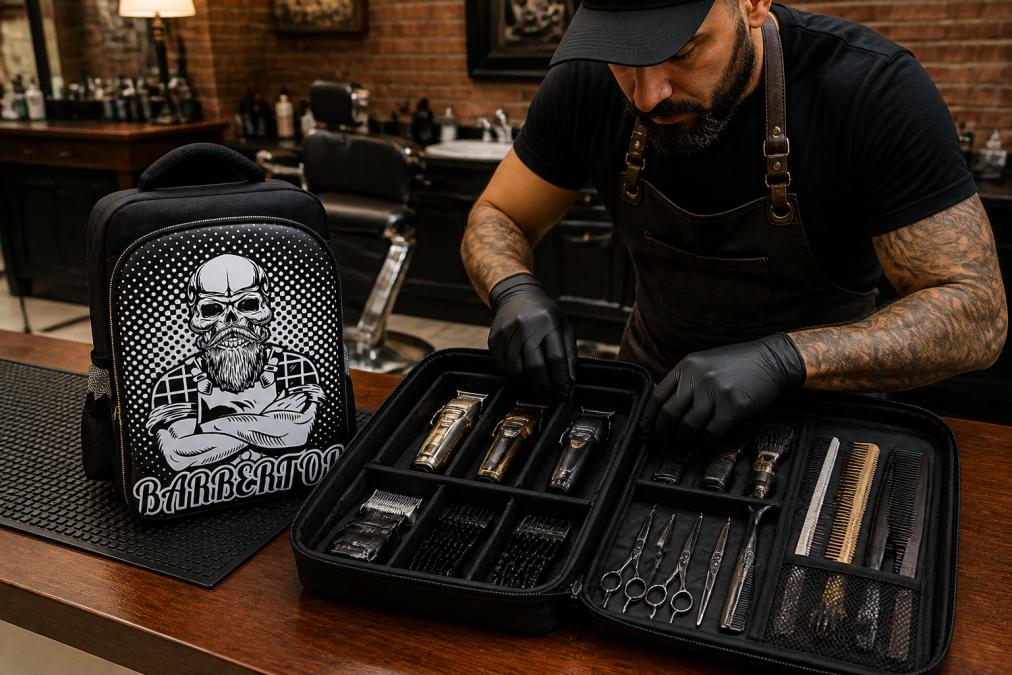
Drawer Dividers and Custom Compartments
Drawer dividers transform a flat case into a functional workspace. They prevent tools from sliding around during transport and keep everything visible at a glance. Most mobile barbers use adjustable dividers that customize compartment sizes based on their tool collection.
Organize by frequency of use. Your most-used clippers go front and center. Less-frequently-used specialty tools go toward the back. Guard sizes should be grouped with their corresponding clipper. Consider vertical storage: combs stand upright better than lying flat, shears fit efficiently in small slots, and clipper guards stack neatly. Label your compartments clearly with adhesive labels or permanent marker to save time during service.
Magnetic Strips for Shears and Combs
Magnetic strips eliminate bulky compartments for metal tools. Mount a magnetic strip on the interior wall of your case. Your shears, combs, and metal tools adhere instantly, staying organized and visible. The advantage is accessibility, you see every tool at once without opening compartments. Choose strong rare-earth magnets rated for the weight of your tools.
Tool Placement for Workflow Efficiency
Organize your station to match the sequence of your actual cutting process. If you always start with a specific clipper and guard combination, that tool should be first. If you use shears for detail work at the end, place them toward the back of your reach zone.
Map out your typical service sequence. Most barbers start with clippers at a certain guard length, transition to shorter guards, then finish with shears or straight razors. Your tool placement should follow this sequence. Create a "staging area" for tools you'll use in the next phase of the cut. Test your layout during actual cuts before finalizing it.
Implement Sanitation Standards for Mobile Barbers
Professional sanitation is non-negotiable for a mobile barber. Your standards must exceed what a stationary shop requires because you have fewer resources.
Disinfect all tools between clients using EPA-approved disinfectant (the EPA). Wipe down clipper blades, shears, combs, and any tool that touched the client's hair or skin. Let the solution sit for the time specified on the product label, usually 30 seconds to 2 minutes (the CDC).
Bring clean towels for every client. Don't reuse towels between appointments. Use neck strips or disposable capes under your primary cape to create a barrier between the cape and the client's skin. Wash your hands before and after each client with soap and water, using hand sanitizer as backup.
Keep your portable station clean between appointments. Dust accumulates during transport. Wipe down the exterior and interior surfaces regularly.
Mobile Barber Setup Ideas for 2026
Modern mobile barber setups balance portability with professionalism. The best setups combine specialized storage solutions with smart weight distribution and cable management.
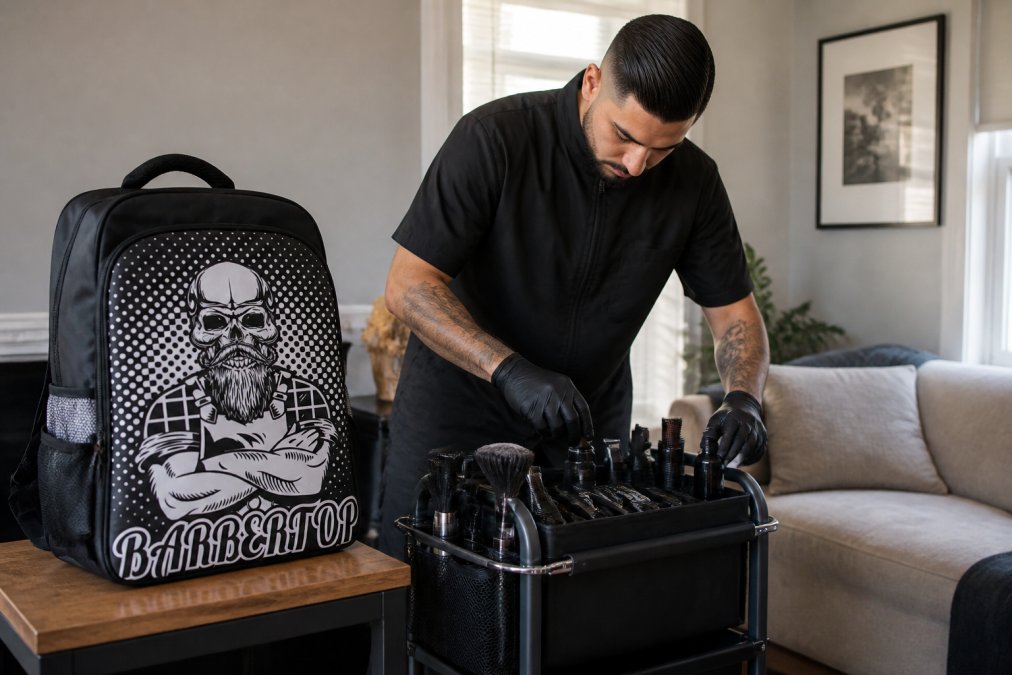
Weight Distribution and Cable Management
Distribute weight evenly across your case or bag. Heavy items should sit low and centered. This prevents strain injuries and makes transport less exhausting.
Coil your clipper charging cables neatly and secure them with small cable ties. Store cables in a dedicated compartment or use cable organizers designed for portable equipment. Loose cables shift during transport and can pinch other tools.
Consider the weight of your charging equipment. Evaluate whether you need multiple chargers or if one universal charger would work for your clipper models. Some mobile barbers reduce weight by carrying only one spare battery per clipper and charging at home between appointments.
Using Trolleys and Mobile Carts
A rolling trolley transforms your portable setup from something you carry to something you roll. This is especially useful if you work from a van or travel between multiple locations in a single day.
Choose a trolley with sturdy wheels that handle uneven surfaces. Organize your trolley with your case as the base, then stack or attach smaller containers for sanitation supplies, capes, and support items. Keep the center of gravity low and balanced. Some mobile barbers use a hybrid method: a trolley for transport between locations and a portable backpack for the actual setup at the client's location.
Protect and Transport Your Equipment
Transportation damage is the silent killer of portable barber equipment. Invest in a quality case designed for your specific tools. The Fade Supply Pro Travel Barber Backpack and Fade Supply 3-Layer Mobile Barber Kit offer water-resistant storage with compartments designed for clipper sets and cutting tools. The Fade Supply Hard-Shell Clipper Case provides hard-shell protection for your most valuable tools.

Pack your case strategically. Heavy items on the bottom, lighter items on top. Delicate tools like shears should have padding around them. Use small towels or foam padding to fill gaps and prevent movement. Secure your case in your vehicle during transport using a seatbelt or cargo net.
Temperature extremes damage equipment. Don't leave your case in a hot car for hours. Clipper batteries degrade faster in heat. In winter, let equipment acclimate to room temperature before use if you've been in a cold vehicle.
Maintain Your Portable Station for Longevity
Regular maintenance prevents equipment failure and keeps your portable barber station functioning reliably.
Clean your clippers after every use. Hair accumulates in the blade area and reduces cutting performance. Use a small brush to remove hair from the blades. Wipe the exterior with a dry cloth.
Oil your clipper blades regularly according to the manufacturer's instructions. Proper oiling keeps blades sharp and prevents rust. Inspect your tools weekly for loose parts, dull blades, or damage. Check your case for damage, zippers fail, compartment dividers crack, and water-resistant seals degrade. Small repairs prevent bigger problems.
Charge your batteries properly. Don't let batteries fully discharge before charging, and avoid overcharging. Follow the manufacturer's guidelines for your specific clipper model. Document your maintenance schedule with a simple log of when you cleaned, oiled, and inspected equipment.
Organizing a portable barber station is about matching your equipment to your actual workflow, not following someone else's ideal setup. Start with the checklist, refine your layout based on real appointments, and invest in quality storage that protects your tools during transport. A well-organized portable barber station lets you focus on your craft instead of hunting for equipment.
At Fade Supply Co, we've designed storage solutions specifically for mobile barbers. The Fade Supply Pro Travel Barber Backpack offers large-capacity organization with water-resistant protection, while the Fade Supply 3-Layer Mobile Barber Kit provides layered compartments for different tool categories. For clipper protection, the Fade Supply Hard-Shell Clipper Case delivers hard-shell durability. These aren't generic bags, they're built by people who understand what mobile barbers actually need. Get started with Fade Supply Co and transform how you transport and organize your portable barber station.

Frequently Asked Questions
What are the essential tools for a portable barber station?
A portable barber station requires clippers with multiple guard sizes, straight razors, scissors, combs, brushes, clipper oil, disinfectant, and a barber cape. For mobile work, add a travel-grade backpack or hard-shell case to protect equipment during transport. The Fade Supply 3-Layer Mobile Barber Kit includes many of these essentials in one organized package designed specifically for traveling barbers.
How do you keep a mobile barber station sanitary and organized?
Store tools in designated compartments immediately after use. Use separate containers for clean and used equipment. Disinfect all metal tools with approved solutions between clients and at the end of each day. Keep a hygiene station with hand sanitizer, disinfectant spray, and clean towels within arm's reach. Establish a checklist to verify sanitation before leaving each client location. Proper organization prevents cross-contamination and ensures quick access to clean tools.
What is the best way to transport barber equipment safely?
Use a hard-shell case or padded backpack designed for barber tools. The Fade Supply Hard-Shell Clipper Case protects clippers and trimmers from impact and moisture. For larger mobile setups, the Fade Supply Pro Travel Barber Backpack offers water-resistant storage with multiple compartments. Secure items so they don't shift during transport, and keep frequently used tools in a separate, easily accessible section. Never leave equipment loose in a vehicle where it can be damaged or contaminated.
How can I maximize space in a small mobile barber setup?
Use vertical storage with magnetic strips for shears and combs, and wall-mounted caddies for clippers and guards. Implement drawer dividers to segment tools by type and frequency of use. Choose a compact trolley with multiple tiers instead of a single large bag. Store rarely used items in a sealed case and bring only daily essentials to each appointment. The Fade Supply Mobile Barber Backpack includes multiple organizer sections and a dedicated laptop compartment, helping you fit everything you need into a smaller footprint.
This article was written using GrandRanker