

Quick Summary
Repetitive strain injuries in barbers are prevented by fixing your station height, using lighter tools with a relaxed grip, taking short breaks between clients, and doing simple stretches before, during and after shifts. Catching early pain and seeing a doctor for tingling or night pain also prevents long-term damage.
- Set the client's head about at your chest height, with the mirror centered at or slightly below eye level.
- Keep frequently used tools within 18-24 inches of your body to avoid stretching or twisting.
- Hold shears with a light pinch and keep your wrist straight rather than bent.
- Take a two-minute reset between clients and a longer break every couple of hours.
- See a doctor for tingling, numbness or pain that wakes you at night or persists on days off.
Table of Contents
- Early Symptoms and When to Seek Medical Care
- Barber Ergonomics: Posture and Workstation Setup
- Choosing Ergonomic Barber Tools That Reduce Strain
- Grip, Hand Position and Cutting Technique
- A Progressive Exercise Routine for Barbers
- Carpal Tunnel Syndrome Prevention Through Breaks and Task Rotation
- Start Protecting Your Hands With the Right Station Setup
- Frequently Asked Questions
What Causes Repetitive Strain Injuries in Barbers
Repetitive strain injuries (RSI) are pain and damage to muscles, tendons and nerves caused by the same movements repeated for hours each day. For barbers, that means the constant twist of a wrist, the squeeze of a clipper and the lean over a client add up. Most barbers don't notice the damage until it starts to hurt during a shift.
The usual culprits are simple. Holding tools too tightly, working with the wrist bent, stretching the arm out to reach a client, and standing in one position for a full day all increase strain. Heavy or unbalanced tools make it worse. So does working through fatigue with no breaks. A busy shop can put 30 or more haircuts through one set of hands each week, and that repetition is the real risk.
Watch out: ignoring early pain is the most common mistake. A sore wrist that "goes away after the weekend" is often the first sign of a problem that keeps building.
Early Symptoms and When to Seek Medical Care
Early symptoms are usually mild and easy to dismiss. Look for a dull ache in the wrist, hand or forearm, stiffness when you wake up, a weak grip, or tingling in the fingers, especially the thumb, index and middle fingers.
Tingling, numbness or pain that wakes you at night, or symptoms that get worse even on days off, call for a visit to a doctor. A healthcare provider can check for conditions such as carpal tunnel syndrome or tendonitis. The National Institute of Arthritis and Musculoskeletal and Skin Diseases offers general information on these conditions and their treatment.
Barber Ergonomics: Posture and Workstation Setup
Good posture is the foundation of injury prevention, but posture is largely dictated by how your station is set up. Stand with your feet about shoulder-width apart, keep your weight balanced, and let your shoulders drop instead of lifting them toward your ears. Bring the client to you rather than reaching across the chair.
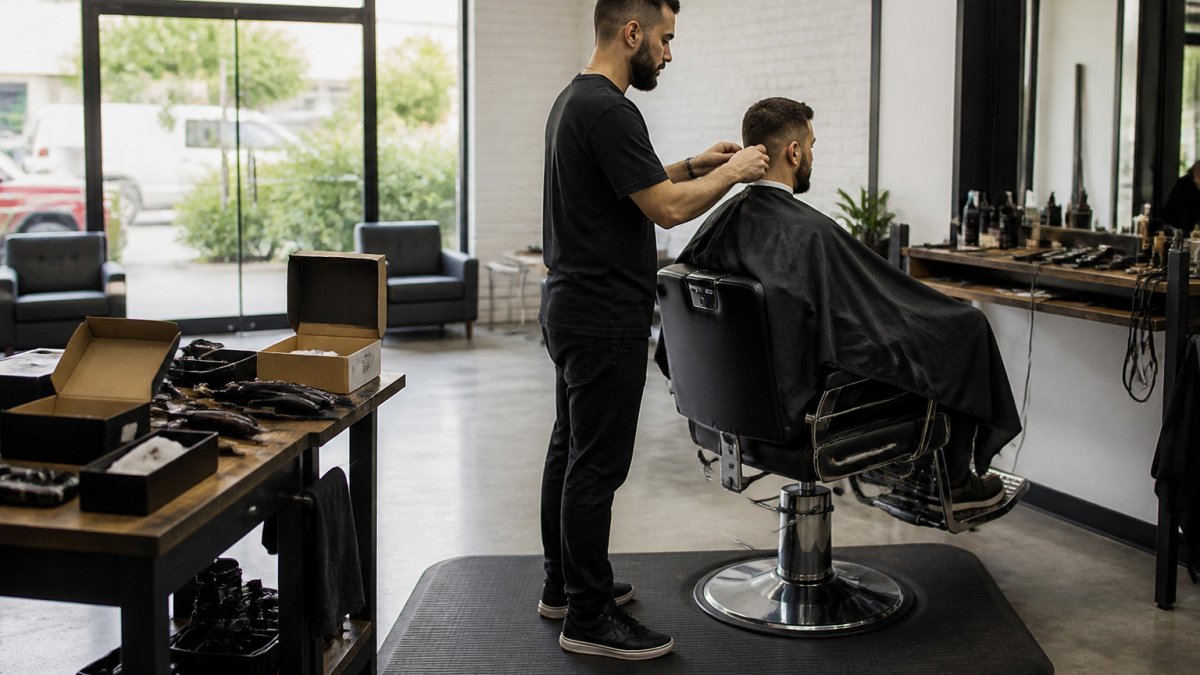
Measure your working height
Stand straight beside the chair and set the seat so the client's head sits at about your chest height when they sit upright. For most barbers, that means the top of the client's head is roughly 4-6 inches below your eye level. Mount the mirror so you can see the full head without tilting your neck; the center of the mirror should be at or slightly below your eye level.
Adapt for your height
- If you are shorter than about 5 feet 4 inches, lower the chair and consider a standing platform or anti-fatigue mat to bring the client's head into your working zone without raising your shoulders.
- If you are taller than about 6 feet, raise the chair and mirror rather than bending at the waist; a taller chair or a adjustable stool lets you sit for detailed work without hunching.
- Use a height-adjustable stool for longer services so you can alternate between standing and sitting without changing the client's position.
Shop layout and reach zones
Keep frequently used tools within an arm's reach zone, roughly 18-24 inches from your body, so you do not stretch or twist. Place heavier clippers and shears at elbow height, and keep less-used items on a lower shelf. A station mat under your tools prevents sliding so you do not need to grip harder to hold them in place.
Test and adjust
Test the setup with a client. If you need to lean, crouch, or hold your arms high for long periods, adjust the chair or mirror again. A common pattern is to set the chair once and never revisit it, even after a new chair or a different client mix. Recheck your setup whenever you change chairs, mirrors, or shop layout.
Watch out: a setup that fits you perfectly may not fit a colleague who shares the station. If multiple barbers use the same chair, mark your preferred height with tape or a note so you can reset it quickly between shifts.
Choosing Ergonomic Barber Tools That Reduce Strain
Tool choice has a direct effect on hand and wrist strain. Lighter clippers with good balance let you cut with less force. Ergonomic shears with comfortable finger rests reduce how tightly you need to grip.
Fade Supply Co carries tools built for long shifts. The Cocco Veloce Lite Cordless Clipper is a lightweight option at $139.00, with an ergonomic housing designed to reduce fatigue. For barbers who want more control, the Gamma+ Shorty Cordless Hair Clipper is priced at $249.99 and includes a high-torque motor that cuts with less effort.

Pay attention to weight, grip shape and how the tool feels in your hand after ten minutes. Compare clipper options in this practical guide to see how to pick lighter, better-balanced clippers.
Clipper overheating can also add strain, since a hot tool often gets gripped harder. Read Prevent Clipper Overheating in Busy Shops for ways to keep tools cooler during long shifts.
Maintenance matters too. Dull blades and dirty clippers require more force. Clean and oil your tools regularly, and replace blades when cuts start to drag.
The article names two clippers from Fade Supply Co with their prices and the key trait each one offers.
| Tool | Price | Key feature |
|---|---|---|
| Cocco Veloce Lite Cordless Clipper | $139.00 | Lightweight, ergonomic housing |
| Gamma+ Shorty Cordless Hair Clipper | $249.99 | High-torque motor, cuts with less effort |
Grip, Hand Position and Cutting Technique
A relaxed grip protects your hands. Hold shears with a light pinch rather than a tight squeeze. Keep your wrist straight, not bent up or down, and let the tool do the work.
Use the Fade Supply Pro Station Mat to keep tools steady so you don't need to grip harder to hold them in place.

Watch out: cutting technique affects strain as much as grip. Short, controlled strokes work better than long, forceful cuts.
A Progressive Exercise Routine for Barbers
A generic stretch list does not match the demands of barbering, where the same wrist flexors, thumb pad, and upper back muscles work for hours. A progressive routine should be built around three phases: a pre-shift warm-up to prepare tissues, between-client micro-movements to interrupt static loading, and an end-of-day cool-down to reduce accumulated tension. Start with the phase-one routine below for two weeks, then add the phase-two progressions only when you can complete the current movements without soreness the next day.
Phase 1: Pre-shift warm-up (3-4 minutes, before your first client)
- Wrist circles: 10 slow circles in each direction, then 10 gentle up-and-down wrist bends.
- Finger spread and squeeze: spread all fingers wide for 5 seconds, then make a soft fist for 5 seconds; repeat 8 times.
- Shoulder rolls: 10 backward and 10 forward, keeping the arms relaxed.
- Neck tilts: tilt each ear toward the shoulder and hold for 10 seconds per side; do not roll the neck.
- Chest opener: clasp hands behind your back, straighten your arms, and hold for 20 seconds.
Phase 2: Between-client micro-movements (60-90 seconds, every 2-3 clients)
- Thumb pad press: press the thumb pad of one hand into the palm of the other and hold for 10 seconds; repeat 3 times per hand.
- Forearm extensor stretch: extend one arm straight, point the fingers down, and use the other hand to gently pull the fingers toward you for 15 seconds per side.
- Standing back extension: place your hands on your lower back and gently lean back for 10 seconds; repeat 3 times.
- Doorway chest stretch: place a forearm on a doorframe and step through for 20 seconds per side.
Phase 3: End-of-day cool-down (5 minutes, after your last client)
- Wrist flexor stretch: extend one arm with the palm up, use the other hand to pull the fingers down toward the floor, and hold for 20 seconds per side.
- Upper trapezius stretch: sit on one hand, tilt the head away from that side, and hold for 20 seconds per side.
- Figure-four stretch for the lower back: sit in a chair, cross one ankle over the opposite knee, and lean forward for 30 seconds per side.
- Deep breathing: 5 slow breaths with a 4-second inhale and 6-second exhale to downshift after a busy shift.
Progression rules
After two weeks, add one repetition to each movement or increase the hold time by 5 seconds, but never push into sharp pain. A common pattern is to progress too quickly after a good week and then skip several days because of soreness. If a movement causes tingling or numbness that lasts more than a few minutes, stop and mention it to a healthcare provider.
Tracking progress
Keep a simple log of pain, numbness, and fatigue on a 0-10 scale before and after each shift. If scores are not improving or are worsening despite consistent practice, that is a signal to reassess your workstation and tool fit rather than simply adding more stretches.
Carpal Tunnel Syndrome Prevention Through Breaks and Task Rotation
Breaks give tired tendons time to recover. Many barbers find a two-minute reset between clients helpful, along with a longer break every couple of hours.
Task rotation also helps. Alternate hands when possible, switch between clipper and shear work, and mix in sweeping or cleaning tasks. If you plan to rotate tasks, you can buy barber tools in bulk to keep spares ready. Changing the movement pattern spreads the load across different muscles.
If symptoms return, see a doctor before continuing the same schedule.
Start Protecting Your Hands With the Right Station Setup
Prevention starts at your station. Check your posture, adjust your chair and mirror, choose tools that fit your hand, and build breaks into every shift. Small habits done every day protect your hands for the long run.
Fade Supply Co builds professional-grade tools and station essentials for barbers at every career stage. Browse the Shop Collection to find equipment that fits your work.
Frequently Asked Questions
What prevents repetitive strain injuries in barbers?
Repetitive strain injuries are prevented by reducing the load on the same tissues over long shifts. Keep wrists in a neutral position rather than bent, use lightweight ergonomic clippers and shears, and avoid squeezing tools harder than the cut requires. Adjust chair and station height so your elbows stay near your sides, schedule short breaks between clients, and rotate tasks where possible. Stretching before and during the day keeps tissues mobile, and addressing pain early stops a minor strain from becoming a chronic injury that forces you out of the chair.
How should barbers hold scissors and clippers to reduce strain?
Hold scissors with a light grip using your thumb and ring finger, letting the index finger guide rather than squeeze. Keep the wrist straight and let the arm move from the shoulder and elbow instead of bending the wrist to follow the cut. Clippers should rest in the palm with the fingers relaxed. The Cocco Veloce Lite Cordless Clipper is a lightweight option with an ergonomic housing, and BaBylissPRO Clipper Grips, priced at $15.99, provide a comfortable, secure hold and better control.
How can barbers prevent carpal tunnel syndrome?
Carpal tunnel syndrome develops when the nerve passing through the wrist is repeatedly compressed, often by bent wrists, forceful gripping and sustained vibration. Prevent it by keeping the wrist neutral, using tools that reduce vibration and grip force, taking breaks during long sessions, and doing gentle wrist and forearm stretches daily. Report numbness or tingling in the fingers early, since catching symptoms sooner gives the best chance of recovery with rest and changes to your technique.
When should a barber seek medical care for hand or wrist pain?
See a healthcare provider if pain, numbness or tingling in the hand, wrist, neck or shoulder lasts more than a few days, wakes you at night, or continues during rest. Weakness in the grip or dropping objects is a sign to get checked promptly. Early evaluation allows a provider to assess the nerves and tendons, recommend treatment and advise on modifying your work so symptoms do not worsen while you recover.
