

Last Updated: October 27, 2026
Quick Summary
Thinning shears are the better choice for bulk removal of heavy, thick sections, because they take out more hair per cut than blending shears. Blending shears suit transitions and soft edges, where you want a slower, more precise reduction in weight. Choose the tool that matches the hair density and the amount of weight you need to remove.
- Thinning shears remove a high amount of hair per cut, versus a low amount for blending shears.
- Standard thinning shears remove roughly 20-35% of a section per full pass, according to practitioners.
- Start with fewer passes than you think you need, since removed hair cannot be put back.
- Fine hair suits blending shears or low-removal thinning shears with a high tooth count.
- Curly hair is the highest-risk category, so use blending shears sparingly and mid-shaft.
Table of Contents
- Thinning Shears vs Blending Shears: The Core Difference
- Bulk Removal vs Controlled Blending: A Side-by-Side Decision Guide
- How Tooth Count Changes the Amount of Hair Removed
- Choosing Shears for Hair Density and Texture
- How to Use Thinning Shears Without Visible Lines
- Texturizing Shears vs Thinning Shears: Where the Line Falls
- Booking Your Next Shear Upgrade at Fade Supply Co
- Frequently Asked Questions
Thinning Shears vs Blending Shears: The Core Difference
Thinning shears and blending shears are both used to reduce weight in a haircut, but they do it in different ways.
Bulk Removal vs Controlled Blending: A Side-by-Side Decision Guide
| Factor | Bulk Removal (Thinning Shears) | Controlled Blending (Blending Shears) |
|---|---|---|
| Hair removed per cut | High | Low |
| Best for | Heavy, thick sections | Transitions and soft edges |
| Risk | Over-thinning, visible gaps | Too little weight removed |
| Pace | Faster reduction | Slower, more precise |
How Tooth Count Changes the Amount of Hair Removed
Tooth count is the most reliable predictor of how much hair a shear removes per snip, but the relationship is not linear and it is not the only variable. Understanding the mechanism lets you read a spec sheet and predict real-world behavior before you buy.
The mechanism: why teeth remove hair at all
Most practitioners find that a standard thinning shear removes roughly 20-35% of the hair in a section per full pass, while a blending shear with fewer, wider-spaced teeth removes closer to 10-20%. Treat those as working ranges, not published specs, manufacturers rarely state exact figures, and blade geometry, hair texture, and cutting angle all shift the result.
Tooth count and spacing in practice
Our Percu Golden Line Thinning Shear 6" uses 40 teeth, while the Percu Pro Barber Cut Line Thinning Shear 6.5" uses 45 teeth.
Reading removal rates without overcutting
A common pattern is that barbers overestimate how much a single pass removes and compensate by cutting too aggressively on the first pass. Slower, lighter passes with a check between each one produce a more even result than one heavy pass followed by correction.
Choosing Shears for Hair Density and Texture
Hair density and texture should drive your shear choice more than brand loyalty, but most guides stop at "thick hair takes more thinning." The useful guidance is hair-type-specific: which tool design, tooth count, and technique fit fine, medium, thick, curly, and textured hair without creating holes, frizz, or irreversible over-removal.
Fine hair
Fine hair has fewer strands per square inch and each strand is smaller in diameter, so a heavy thinning pass shows immediately as patchiness. Use a blending shear or a low-removal thinning shear with narrow spacing and a high tooth count, and cut mid-shaft rather than at the root or the ends. Avoid double-thinning shears on fine hair unless you are working on a very dense crown, the removal rate is too high for the margin of error.
Medium density, straight hair
This is the most forgiving category. A standard 40-45 tooth thinning shear works well for bulk removal, and a blending shear handles transitions. The main risk is over-thinning the ends, which makes straight hair look stringy. Keep bulk removal to the interior of the section and reserve the perimeter for blending passes.
Percu Fantastica Line Professional Thinning Shears 6.5'' Assorted Colors →
Thick, coarse hair
Thick hair handles bulk removal well because the teeth have plenty of hair to grab and the section recovers visually from a heavier pass. A lower-tooth-count shear or a double-thinning shear speeds up weight reduction. Work in horizontal subsections and check the silhouette from the front and side before moving to the next section, coarse hair can hide weight until the client stands up.
Curly and textured hair
Curly hair is the highest-risk category for thinning shears. Cutting into a curl cluster can create frizz, disrupt the curl pattern, and leave gaps that only show when the hair is styled. Most practitioners find that blending shears with wide-spaced teeth, used sparingly and mid-shaft, are safer than aggressive thinning. Never thin the perimeter of a curly cut; work inside the shape and let the curl pattern hide the removal. For tightly coiled hair, test on a hidden section first and allow the hair to dry before judging the result.
Matching the tool to the head in front of you
Our Percu Futura Line Double Thinning Shear 6.5" features 60 HRC hardness. The Percu Virtual Line Thinning Shear 6.5" is priced at $49.99.
How to Use Thinning Shears Without Visible Lines
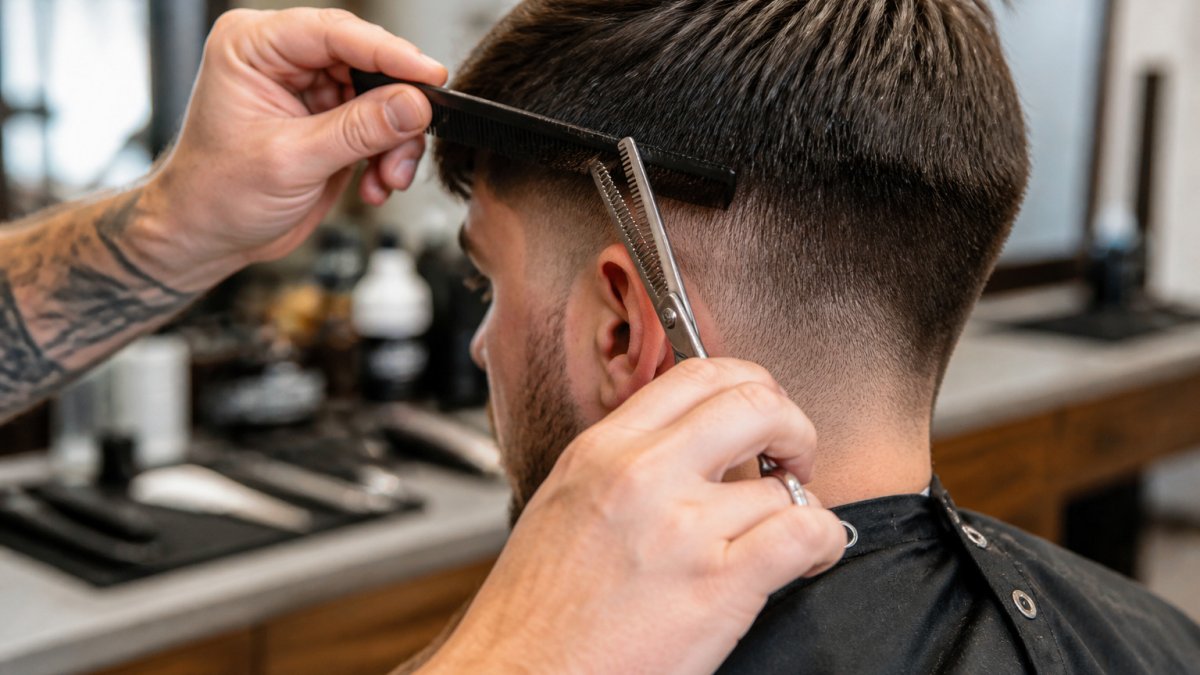
Close-up of a barber's hands holding a 6.5 inch thinning shear while softly blending the ends of a client's haircut in a bright barbershop.
Texturizing Shears vs Thinning Shears: Where the Line Falls
For most bulk removal jobs, thinning shears are the right tool. Texturizing work sits closer to the blending end of the spectrum, where you want movement without heavy weight loss. For a guide to blending hair with clipper guards as an alternative approach, see how to blend hair with clipper guards.
Booking Your Next Shear Upgrade at Fade Supply Co
If you are ready to compare options, browse the full thinning shear collection at Fade Supply Co. Our team stocks a range of tooth counts and finishes, from the 40-tooth Golden Line to the 45-tooth Pro Barber model, so you can match the tool to your density and workload. shop thinning shears to see the full range, or compare double thinning shears if you want heavier bulk removal. Shipping is quick, so your station stays stocked between client bookings.

Frequently Asked Questions
What is the difference between thinning shears and blending shears?
Thinning shears and blending shears are largely the same tool. Both have teeth on one blade, and the main practical difference is how much hair they remove. Thinning shears with fewer, wider-spaced teeth remove more hair per cut, which suits bulk reduction. Blending shears with more teeth remove less, which suits softening transitions and refining movement. Check the tooth count on the listing, since the label alone does not tell you the removal rate.
Which shears are best for removing bulk from thick hair?
The Percu Pro Barber Cut Line Thinning Shear 6.5" has a 45-tooth blade, and the Percu Golden Line Thinning Shear 6" has 40 teeth.
How many teeth should thinning shears have?
The Percu Golden Line Thinning Shear 6" has 40 teeth, and the Percu Pro Barber Cut Line Thinning Shear 6.5" has 45 teeth.
Can thinning shears be used for blending?
Yes. Thinning shears can blend, and many barbers use them for both jobs. Blending works best when you use a light scissor-over-comb technique and cut into the hair, not straight across it. Reserve heavy removal for areas with real bulk, and switch to a higher-tooth shear when you are refining the final transition.
