

Table of Contents
- Why Blade Choice Decides a Bald Fade
- Best Clipper Blades for Bald Fades: Quick Comparison
- Zero Gap Clipper Blades: What They Do and Who Needs Them
- How to Zero Gap Clippers Without Damaging the Blade
- Blade Heat, Sanitization, and Skin Safety
- Clipper Blade Maintenance for Barbers: Oiling, Cleaning, and Storage
- Matching Blades to Hair Type and Clipper Motor
- Conclusion
- Frequently Asked Questions
Last Updated: September 14, 2026
Why Blade Choice Decides a Bald Fade
The best clipper blades for bald fades are zero-gap adjustable blades with fine, staggered teeth and coated cutting surfaces that stay cool against skin. That combination separates a fade that looks painted on from one that shows shadow lines and irritation.
A bald fade lives or dies at the bottom inch of the cut. The blade must cut closer than a standard fade blade, glide over skin without snagging, and stay cool enough that the client doesn't flinch. It's also a compatibility question: a blade that pairs beautifully with one clipper's motor can chatter on another.
Best Clipper Blades for Bald Fades: Quick Comparison
The table below maps each clipper in our lineup to its blade and the barber it suits best. Prices are current listings at Fade Supply Co.
| Clipper | Blade | Cut Range | Best For | Price |
|---|---|---|---|---|
| JRL FreshFade #FF2020C | Cool Blade, lever-locking | 0.5-3.5mm | All-day cordless fades | $154.99 |
| Wahl 5-Star Vapor | F32 FADEOUT adjustable balding | 0.5-1.2mm | Seamless balding and close fading | $200.99 |
| BaBylissPRO FXONE Lo-ProFX | Blue Titanium MIM fade, zero-gap | Zero-gap adjustable | High-volume skin fades | $254.99 |
| StyleCraft Instinct-X | Black Diamond DLC fade + Shallow 2.0 | Zero-gap adjustable | Torque control on thick hair | $269.95 |
| Andis Master Cordless | Carbon-steel, 000 to 1 | 000-1 | All hair types and textures | $229.00 |
| Wahl 5 Star Cordless Senior | 2191 fade blade, zero-overlap | Zero-overlap adjustable | Traditional tapering and fading | $164.99 |
| Wahl Cordless Legend | Wedge blade | Standard fade range | Lightweight daily work | $144.99 |
| Wahl Magic Clip | Stagger-Tooth #2161-700 | 1/16"-1" guides | Cord or cordless flexibility | $139.99 |
| StyleCraft Instinct | Gold Titanium Faper + Black Diamond | Zero-gap adjustable | Bulk removal and blending | $259.95 |
| StyleCraft Ergo | Black Diamond Carbon DLC | Zero-gap adjustable | Comfort on long shifts | $149.95 |
What Separates a Balding Blade From a Standard Fade Blade
A balding blade closes tighter than a standard fade blade and feeds hair more consistently at skin level. The difference shows up in tooth geometry, coating, and taper lever travel.

Standard fade blades bottom out with a visible shadow; balding blades eliminate it. The Wahl 5-Star Vapor's F32 FADEOUT blade uses 32 fine ball-point teeth with deeper channels, plus black PVD and DLC coatings for rust resistance and longer sharpness.
Coating matters more than most barbers expect. Titanium and DLC coatings on blades like the Magic Clip's Stagger-Tooth stay cooler and hold an edge far longer than bare steel, on a busy Saturday, the difference between one blade change and three.
Zero Gap Clipper Blades: What They Do and Who Needs Them
Zero gap clipper blades are adjusted so the moving cutter sits flush with the fixed blade, leaving no gap for hair to slip between, an ultra-close cut that behaves closer to a razor than a standard clipper pass.
The Mechanics Behind the Cut
A standard fade blade leaves a small gap between the moving cutter and the fixed blade. Hair that slips into that gap gets pushed rather than sliced, which is why a standard blade bottoms out with a visible shadow. Closing the gap removes that escape route: every strand meets a cutting edge instead of sliding past it.
The trade-off is friction. When the cutter runs flush against the fixed blade, the surfaces are in near-constant contact, generating heat, loading the motor, and accelerating wear on the edge and coating. A zero-gapped blade that runs cool on a 7,200 SPM motor can run noticeably hotter on a lower-torque motor.
Who Actually Needs a Zero-Gap Setup
Barbers cutting skin fades, bald fades, and precision outlining. If your clientele asks for a razor-like finish at the neckline and temples, zero gap is not optional.
If you mostly cut scissor-over-comb and longer tapers, a zero-gap setup buys you little and costs you blade life.
The Failure Modes Nobody Warns You About
Three things go wrong when a zero-gap adjustment is careless:
- Over-tightening. The cutter presses hard against the fixed blade, the motor tone drops, and the blade overheats within minutes, the fastest way to kill a blade.
- Misalignment. One side of the cutter sits closer than the other. The fade shows lines, and the client feels a pull on one side of the pass but not the other.
- Coating wear. A blade never meant to run flush (bare steel, thin PVD) loses its coating fast under constant contact. Titanium or DLC handles zero-gap duty far better.
Matching the Blade to the Motor Before You Zero-Gap
Not every blade belongs at zero gap. A high-tooth-count balding blade with deep channels handles the tighter tolerance well because the channels clear cut hair and reduce drag. A shallow-tooth standard blade zero-gapped on a low-torque motor will chatter and stall in thick hair.
Before you adjust, confirm the blade is designed to be adjustable (most balding and fade blades are; many standard taper blades are not) and the motor has enough torque to drive the cutter without bogging down. If the motor tone drops, back the gap off until it recovers. A blade that cuts cleanly at a hair's-width gap beats one that cuts marginally closer and stalls mid-fade.
How to Zero Gap Clippers Without Damaging the Blade
Zero gapping takes about ten minutes and one small screwdriver. The goal is alignment, not maximum tightness.
- Power off and remove the blade guard. Work on a clean, well-lit surface so you can see the tooth edges.
- Locate the two blade screws. On most clippers these sit at the front of the blade assembly.
- Loosen both screws slightly. You want the blade to move, not to come free.
- Slide the moving cutter toward the fixed blade. Bring the teeth as close as they will sit without overlapping.
- Check alignment with a straight edge. The teeth should run parallel across the full width. Misalignment causes lines in the fade.
- Tighten the screws and test. Run the clipper and listen for a smooth, even tone.
- Verify on skin. A properly zero-gapped blade cuts cleanly with light pressure and no pulling.
Expected result: a blade that cuts at skin level with no visible gap, no chatter, and no heat spike after two minutes of continuous running.
Blade Heat, Sanitization, and Skin Safety
Blade heat is the most underrated cause of a bad fade. A hot blade pulls, irritates, and leaves the client flinching through the finish work.
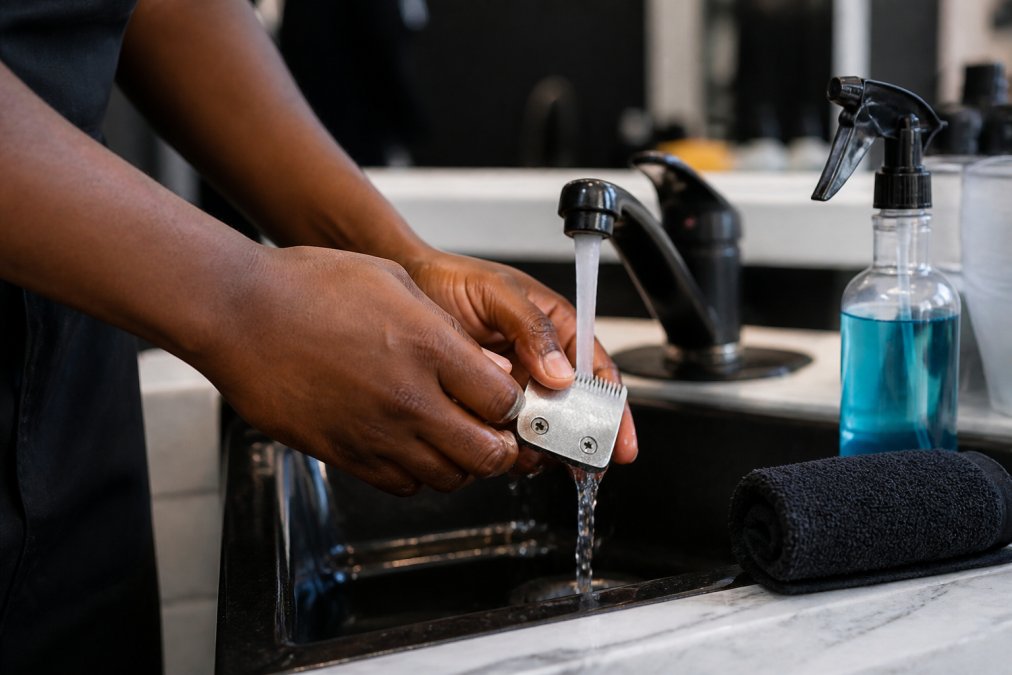
Manage heat with technique, not just breaks. Keep a second blade or clipper on rotation during back-to-back skin fades, and let the blade cool at room temperature rather than dunking hot steel in cold water, which can warp it. Clippers with dedicated cooling designs, like the JRL FreshFade's Cool Blade, give you more working time before heat becomes a problem.
Sanitization is a two-step process, not a wipe-down. Clean visible hair and debris off the blade first, then apply an EPA-registered disinfectant that carries a claim against bloodborne pathogens, following the contact time on the label (the EPA). The EPA's list of registered disinfectants is the reference point for products that actually meet the standard.
For clients with sensitive skin, use light pressure, keep the blade cool, and finish with a soothing post-cut product rather than alcohol-based tonics. Irritation usually traces back to heat, dull teeth, or a blade that was never properly disinfected between clients.
Clipper Blade Maintenance for Barbers: Oiling, Cleaning, and Storage
Clipper blade maintenance for barbers comes down to four habits: oil after every cut, brush out debris between clients, disinfect before reuse, and store blades dry and covered.
- Oil the blade with two or three drops of clipper oil after each client
- Brush hair out of the tooth channels before oiling
- Wipe the blade down, then disinfect with an EPA-registered product
- Let the blade dry fully before storing
- Store blades in a blade guard or case, never loose in a drawer
- Replace blades when they pull, snag, or run hot
Oiling is where most barbers get lazy, and it shows. A dry blade runs hot, cuts rough, and wears its coating faster. The Wahl Cordless Legend ships with a full kit including blade oil and a cleaning brush for exactly this reason.
Sanitizing Skin-Contact Blades Without Dulling the Edge
A bald fade blade touches skin directly, which puts it in a different hygiene category than a blade that only ever meets hair. That means a two-step process, not a wipe-down.
First, remove visible debris. Brush hair out of the tooth channels and wipe the blade with a clean towel. Disinfectant cannot reach a surface that is still coated in hair and oil.
Second, apply an EPA-registered disinfectant that carries a claim against bloodborne pathogens, and let it sit for the full contact time printed on the label. The EPA's list of registered disinfectants is the reference point for products that actually meet the standard. Shortening the contact time is the most common mistake, a five-second spray does not disinfect, it just wets the blade.
What you should not do is soak a blade in alcohol or a harsh solvent for extended periods. Alcohol strips lubricant, dries out the internal mechanism, and over time can dull the cutting edge and degrade coatings. A quick wipe with an alcohol pad is fine between clients; a long soak is not.
Blade Compatibility: Replacing a Worn Blade Without Buying a New Clipper
When a blade finally dulls past recovery, most barbers assume the clipper is done. Usually it isn't, the blade is a wear part, and most professional clippers accept replacement blades from the same manufacturer's line.
But blade-to-clipper fit is not universal. A blade designed for one clipper body often will not seat correctly on another, even within the same brand. Tooth count, mounting screw pattern, and blade bracket shape all vary. Before ordering a replacement:
- Confirm the blade model number matches your clipper model, not just the brand.
- Check whether the blade is adjustable or fixed, an adjustable blade on a clipper with a fixed-blade bracket will not engage the taper lever.
- Verify the coating and tooth count match what you were running, or you will feel the difference on the first pass.
Keep one spare blade per clipper on hand. Swapping a fresh blade mid-shift takes under a minute and keeps a hot, dull blade out of rotation.
Storage and the Rust Problem
Storage matters as much as cleaning. Moisture left on a blade between shifts rusts teeth and dulls edges, and a blade protector costs nothing.
Store blades dry, covered, and away from the sink. In a humid shop, a small silica packet in the blade case absorbs overnight moisture. Coatings slow rust but do not stop it, a chipped DLC or titanium coating exposes bare steel underneath, and that spot rusts first.
Matching Blades to Hair Type and Clipper Motor
Blade and motor have to match. A high-tooth-count blade on a low-torque motor will stall in thick, coarse hair; a heavy blade on a fast motor wastes the speed.
Thick, coarse, or curly hair needs torque and a blade with deep tooth channels that feed hair consistently. The StyleCraft Instinct-X pairs an 11,500 SPM Vector motor with real-time torque adjustment, keeping the cut going when the blade hits resistance. The Wahl 5 Star Cordless Senior's rotary motor pushes through the thickest hair without bogging down.

Fine or thinning hair rewards a lighter touch. The StyleCraft Ergo's 10,000 RPM magnetic motor and Black Diamond Carbon DLC blade cut smoothly with low vibration, reducing the chance of catching fine hair and pulling.
For cordless convenience across a full shift, battery runtime is the deciding spec. The Vapor runs 150 minutes on a charge, the Instinct-X up to 4 hours, and the Andis Master Cordless over 90 minutes. A mobile barber should prioritize runtime and a compact charging setup over raw motor speed.
Conclusion
The right blade setup turns a bald fade from a fight into a routine. Zero-gap alignment, a coated balding blade, cool running temperature, and disciplined maintenance do more for your finish than any single upgrade.
Fade Supply Co stocks professional-grade clippers and station essentials chosen from real experience behind the chair, from the JRL FreshFade's Cool Blade to the Wahl Vapor's F32 FADEOUT balding blade. Veteran-owned, built for students and shop owners alike, with quick shipping to keep your station stocked.
Shop the collection at Fade Supply Co and give every client the skin-tight finish your work deserves.
Frequently Asked Questions
What clipper blade is best for fading and bald fades?
A zero-gap adjustable balding blade with fine, closely spaced teeth gives the closest cut. The Wahl 5-Star Vapor's F32 FADEOUT blade carries 32 ball-point teeth and adjusts to 0.5mm, while the BaBylissPRO FXONE Lo-ProFX uses a Blue Titanium MIM fade blade with a built-in oil reservoir. For bald fades specifically, look for a blade you can zero-gap and that stays cool during back-to-back cuts.
How do you zero gap clippers correctly?
Turn the clipper off and remove the blade guard. Loosen the two screws holding the moving blade, then slide it until the cutting teeth sit just behind the fixed blade's teeth. Most barbers leave a hair's width of clearance to avoid nicking skin. Tighten the screws, run the clipper for a few seconds, and test on your forearm. The Wahl 5 Star Cordless Senior and StyleCraft Instinct both ship with zero-overlap adjustable blades.
How often should barbers oil and clean clipper blades?
Oil the blade before every client and brush out hair dust after each cut. A full clean with a soft brush and a drop of clipper oil at the blade junction takes under a minute. Blades with DLC or titanium coatings, like those on the Wahl Magic Clip, hold sharpness up to four times longer than plain steel, but they still need daily oiling to keep cutting performance consistent.
Can zero-gapped blades cause scalp irritation?
Yes, if the blade runs hot or sits too tight against the skin. Zero-gap blades cut closer, so friction and heat build faster. Use a clipper with a cool-running blade, like the JRL FreshFade's Cool Blade or the Wahl Vapor's brushless motor, and disinfect the blade between clients. For sensitive scalps, keep a light touch and avoid pressing the blade flat against the head.