

Table of Contents
- What Makes a Professional Barber Clipper Guard Set Worth the Investment
- Clipper Guard Size Chart for Barbers: Finding Your Cutting Lengths
- Universal Clipper Guard Compatibility: What Actually Works Together
- Magnetic vs Plastic Clipper Guards: Material, Durability, and Performance
- Professional-Grade Guard Sets for High-Volume Shops and Mobile Barbers
- Maintenance and Troubleshooting: Keeping Guards Tight and Performing
- How to Choose the Right Barber Clipper Guard Set for Your Station
Last Updated: August 30, 2026
What Makes a Professional Barber Clipper Guard Set Worth the Investment
A professional barber clipper guard set is more than just plastic combs, it's the difference between a fade that holds its shape for two weeks and one that starts fading after three days. At Fade Supply Co, we work directly with barbers who understand that cheap guards slip, wear unevenly, and force you to compensate with technique. That costs time. Time costs money.
The real question isn't whether to invest in a quality barber clipper guard set. It's whether you can afford not to. A professional-grade set ensures consistent cutting lengths, reduces blade wear, and eliminates the frustration of guards that don't stay tight during high-volume work. When you're cutting 15-20 heads a day, every second counts (bls.gov).
Here's what separates investment-grade sets from drugstore alternatives: precision engineering. Professional guards are manufactured to tighter tolerances, use durable materials that resist warping, and attach with systems designed for repeated daily use. They maintain blade alignment so your clipper performs the same at guard 5 as it does at guard 1.
The cost varies depending on quantity, material, and attachment system, but professional barbers consistently report that upgrading to quality guards pays for itself through faster service times and fewer customer complaints about uneven fades.
Clipper Guard Size Chart for Barbers: Finding Your Cutting Lengths
Clipper guard sizes are measured in fractions of an inch, and understanding the progression is essential for consistent fading. The standard sizing runs from 1/16 inch (the shortest, closest to skin) up to 1 inch or longer, with each size creating a distinct cutting length that stacks into your fade pattern.
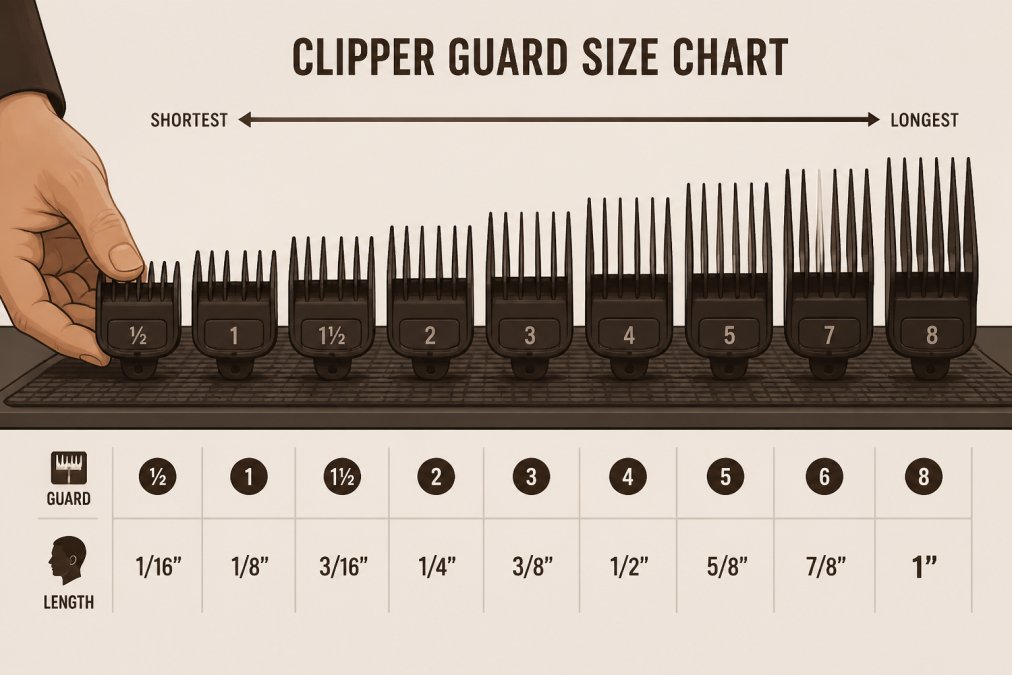
Here's the breakdown of common guard sizes and their practical application:
| Guard Size | Cutting Length | Primary Use | Fade Position |
|---|---|---|---|
| 1/16" | 1/16 inch | Skin-tight lines, detail work | Outline/shadow |
| 1/8" | 1/8 inch | Close cut, shadow fade | First fade layer |
| 1/4" | 1/4 inch | Tight fade, blending | Second fade layer |
| 3/8" | 3/8 inch | Mid-fade transition | Fade blend |
| 1/2" | 1/2 inch | Upper fade, length | Fade to top |
| 3/4" | 3/4 inch | Full length, bulk | Top section |
| 1" | 1 inch | Maximum length | Guard only |
The reason this matters: a true 1/4 inch guard cuts at exactly 1/4 inch, not "approximately." That consistency is what lets you build predictable fades. A guard that cuts at 5/32 inch instead throws off your entire progression.
Most barbers working fades use guards in the 1/16 through 1/2 inch range daily. The larger sizes (3/4 and 1 inch) are for bulk cutting and blending longer hair, but they're essential for full-service barbering. Mobile barbers often carry a compact set focused on 1/16 through 1/2 to save space, while shop stations typically stock the full range.
The key insight most guides miss: guard size tolerance matters more than the number of guards you own. Five perfectly accurate guards beat ten mediocre ones every time. Fade Supply Co's professional sets prioritize accuracy over quantity, which is why barbers report tighter, more consistent fades with fewer guards than they used with budget alternatives.
Universal Clipper Guard Compatibility: What Actually Works Together
Not all clipper guards fit all clippers. This is the single biggest source of frustration for barbers buying online or switching brands. A guard that fits a Wahl clipper may not fit an Andis, and even within the same brand, older and newer models sometimes use different attachment systems.
Universal compatibility is a marketing term that often means "works with most major brands", not actually universal. The two main attachment systems are snap-on (plastic tabs that click into grooves on the clipper blade) and magnetic (metal backing that adheres to a magnetic blade). Some newer professional clippers use hybrid systems that accept both.
Before buying a barber clipper guard set, verify three things: your clipper brand and model, the attachment system it uses, and whether the guards you're considering are explicitly listed as compatible. Fade Supply Co provides detailed compatibility information for every set we carry, because guessing costs you money and downtime.
Snap-on guards are the industry standard for most professional clippers. They're reliable, secure, and don't require any magnetic blade modification. The plastic tabs fit into corresponding slots on the blade, and the guard locks firmly in place. The downside: if the tabs wear or crack, the guard becomes unusable.
Magnetic guards appeal to barbers who want faster guard changes. You attach a thin magnetic backing to your blade once, then swap guards instantly without fiddling with tabs. This works beautifully for high-volume shops where you're changing guards constantly. The trade-off is that magnetic systems require blade modification, and not all clipper models support them.
A practical approach: if you're running multiple clippers in a shop, standardize on one attachment system across all your tools. Mixed systems mean you need to track which guards fit which clippers, and that complexity costs time during service.
Magnetic vs Plastic Clipper Guards: Material, Durability, and Performance
The material of your clipper guard affects cutting performance, durability, and how long it lasts under daily use. This isn't just about longevity, it's about whether your guard maintains its shape and precision over hundreds of cuts.
Professional-grade plastic guards are engineered to resist warping from heat, moisture, and repeated pressure (astm.org). Standard plastic guards can warp over time, especially in humid environments or when exposed to clipper heat. A warped guard no longer cuts at its rated length, throwing off your fade progression.
Metal-backed guards (used in magnetic systems) combine a metal attachment plate with plastic cutting teeth. The metal provides a rigid foundation that won't warp, and the plastic teeth maintain the cutting edge. This hybrid approach delivers the precision of metal with the cutting performance of plastic. Metal-backed guards are also more durable for high-volume shops because the metal backing distributes stress more evenly than plastic alone.
Durability comparison:
- Standard plastic: 6-12 months of heavy use before noticeable wear (peer-reviewed research)
- Professional plastic: 12-18 months before wear becomes visible
- Metal-backed: 18-24+ months with minimal degradation
The cost difference between professional plastic and metal-backed guards is typically modest, but the durability difference is significant. A barber cutting 20 heads daily will see the investment pay off within weeks.
One thing most guides don't mention: humidity matters. In a busy shop with constant water spray and steam, plastic guards absorb moisture and can swell slightly. This changes the cutting length marginally, not enough to notice on one fade, but enough to accumulate over a day's work. Metal-backed guards are immune to this because the metal backing prevents moisture absorption.
Professional-Grade Guard Sets for High-Volume Shops and Mobile Barbers
High-volume shops and mobile barbers have different requirements, and the right barber clipper guard set depends on your specific workflow.
For a shop with five or more chairs, you need redundancy. If one set of guards fails, you can't service clients. Professional shops typically buy two complete sets so there's always a backup while one set is being cleaned or repaired. You also want to standardize on compatible guards across all clippers, which means buying sets that work with your existing equipment.
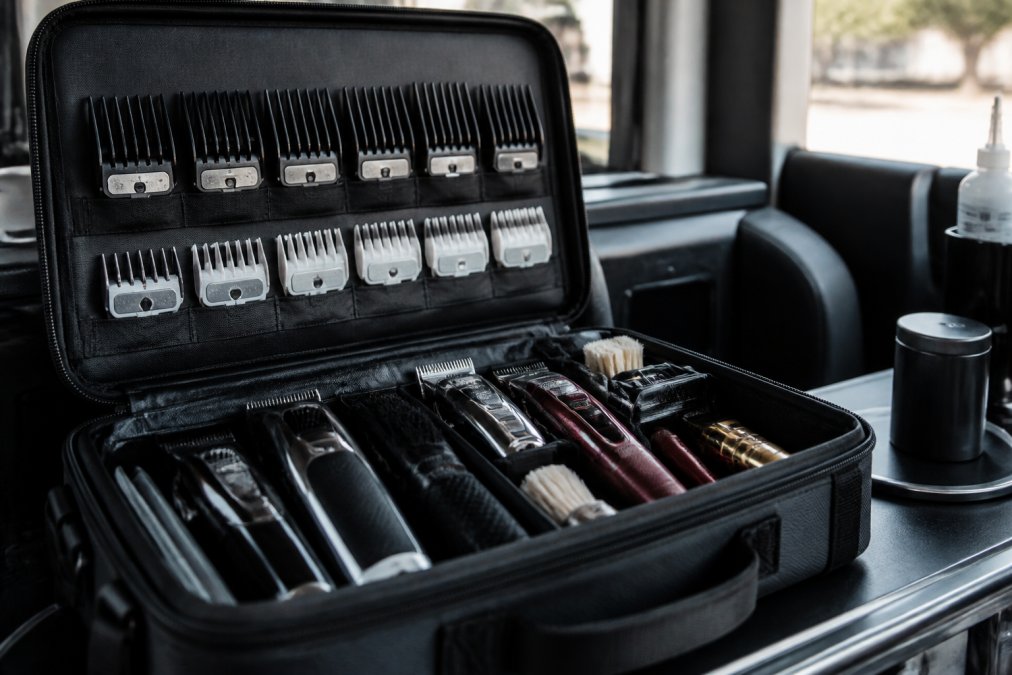
Shop owners should prioritize:
- Complete size range (1/16 through 1 inch) for versatility
- Durable materials that survive frequent cleaning and high-volume use
- Compatible attachment system across all clippers
- Bulk pricing for multiple sets
Mobile barbers operate under different constraints. Space is limited, and you're carrying your entire station. A mobile barber's ideal set includes the sizes you use most (typically 1/16 through 3/4 inch) in a compact, organized case that fits in a vehicle or portable bag. You sacrifice the largest guards to save space, since you're primarily doing fades and detail work rather than bulk cutting.
Mobile barber priorities:
- Compact organization (carrying case or roll-up pouch)
- Sizes 1/16 through 3/4 inch (covers 95% of fade work)
- Lightweight materials that don't add bulk
- Quick-change attachment system for efficiency
The best mobile barber sets from Fade Supply Co are designed for this exact workflow. They include professional-grade guards in a carrying case that slides into a backpack or car organizer. You get durability and precision without the bulk of a full shop set.
Professional-grade sets cost more upfront, but mobile barbers report recovering the investment within their first month of increased service speed and customer satisfaction.
Maintenance and Troubleshooting: Keeping Guards Tight and Performing
A loose guard is useless. It won't cut cleanly, it can slip during a fade, and it frustrates you mid-service. Most loose guards are caused by worn attachment tabs, bent plastic, or improper installation, not defective guards.
Proper maintenance prevents most problems. After each client, rinse your guards with warm water and a brush to remove hair and clipper oil buildup. Dry them completely before storing. Once a week, soak your guards in warm soapy water for 10 minutes, scrub gently with an old toothbrush, and air dry. This prevents oil accumulation that can affect guard fit.
When a guard starts feeling loose:
Check the attachment tabs first. If your guard uses snap-on tabs, inspect them for cracks or wear. Hold the guard up to light and look for gaps or damage. If a tab is cracked, that guard is done, a cracked tab can break completely during use and damage your clipper blade.
Inspect the clipper blade grooves. If the tabs are fine but the guard still feels loose, your blade's attachment grooves may be worn or have debris. Clean the grooves with a small brush and try again. Sometimes a tiny piece of hair or dried oil is the culprit.
Test the guard on a different clipper. If it's loose on one clipper but tight on another, the problem is your blade, not the guard. The blade's grooves are worn and need replacement.
For magnetic guards, looseness usually means the magnetic backing is peeling away from the plastic. This happens if the guard hits something hard or gets dropped. A loose magnetic backing can't be repaired, replace the guard.
Common mistakes that cause premature wear:
- Storing guards while wet (causes plastic to swell and warp)
- Dropping guards on hard surfaces (cracks tabs or bends plastic)
- Leaving guards attached to clippers overnight (pressure on tabs causes permanent deformation)
- Using guards with dull blades (forces you to apply extra pressure, stressing the guard)
Professional barbers remove guards after each use and store them in a dry, organized container. This simple habit extends guard life by months.
How to Choose the Right Barber Clipper Guard Set for Your Station
Choosing the right barber clipper guard set comes down to four decisions: size range, attachment system, material quality, and your specific use case.
Step 1: Identify your clipper model and attachment system. Look at your clipper blade. Does it have small grooves running perpendicular to the blade (snap-on tabs fit here), or is it magnetic? Check your clipper manual or the manufacturer's website if you're unsure. This determines which guards are compatible.
Step 2: Determine your size needs. If you're a shop, you need the full range (1/16 through 1 inch). If you're a mobile barber, focus on 1/16 through 3/4 inch. If you're a student or starting out, a starter set with 1/16, 1/4, 1/2, and 3/4 inch gives you enough to learn fading without overspending.
Step 3: Evaluate material and durability. Professional plastic guards are worth the upgrade over standard plastic. If you're cutting 15+ heads daily, metal-backed guards deliver better long-term value despite higher upfront cost.
Step 4: Consider your workflow. High-volume shops need backup sets and bulk pricing. Mobile barbers need compact organization. Home use or occasional barbering can work with a basic set. Your workflow determines whether you need redundancy, portability, or maximum size range.
At Fade Supply Co, we've built professional-grade sets specifically for these different scenarios. Our shop sets include full size ranges with durable materials designed for constant use. Our mobile barber sets prioritize compact organization without sacrificing quality. Every set we carry is selected based on real-world experience behind the chair, because we know that the right tools make your work faster and your fades sharper.
The investment in quality guards pays for itself through faster service times, fewer customer complaints, and equipment that lasts. When you're relying on your tools to define your reputation, compromise isn't an option.
Choosing professional-grade barber clipper guard sets requires understanding compatibility, material durability, and your specific workflow. The right set eliminates frustration, speeds up your service, and delivers the consistent fades your clients expect. Fade Supply Co's professional-grade sets are built for barbers who won't compromise on quality, whether you're running a high-volume shop, working mobile, or building your skills as a student. Shop our collection and experience the difference that precision equipment makes in your daily work.
Frequently Asked Questions
Will all clipper guards fit all clippers?
No. Clipper guards use different attachment systems, magnetic, snap-on, or clip-on, and blade widths vary by brand. Before buying a barber clipper guard set, verify the attachment type and blade width match your specific clippers. Universal compatibility is limited; most professional-grade guards work only with their intended clipper models.
What clipper guard sizes do professional barbers typically use?
Professional barbers typically stock guards ranging from 1/16 inch for skin-tight fades to 3/4 inch for bulk cutting. Most high-volume shops keep guards in 1/8-inch increments across this range. Your actual set depends on your specialty, fade specialists may prioritize shorter guards, while barbers doing longer styles need mid-to-longer lengths for precision trimming and consistent length.
What's the difference between magnetic and plastic clipper guards?
Magnetic guards attach securely with minimal play, reducing blade misalignment and ensuring consistent cutting performance. Plastic clip-on guards are lighter and portable but can loosen during high-volume work, causing uneven cuts. Magnetic systems can offer superior precision and durability for professional barbering, especially in busy shops where reliability matters.
How often should you replace your clipper guard sets?
Professional-grade guards can last a significant time with proper maintenance in high-volume shops. Replace individual guards sooner if they crack, lose magnetic strength, or become misaligned. Regular cleaning and storage prevent premature wear. Investing in durable plastic or metal guards extends the lifespan compared to consumer-grade alternatives, reducing replacement frequency and total cost.
This article was written using GrandRanker